
Why Easy Isn’t Enough
When organizations introduce AI into the workplace, there’s often a moment of genuine confusion at the leadership level. The technology is obviously faster: it can summarize a document in seconds, draft an email almost instantly, and analyze data that used to take hours. Leadership assumes adoption will follow naturally. Why wouldn’t people embrace something that saves them time?
And yet, in nearly every rollout I’ve watched, plenty of them don’t.
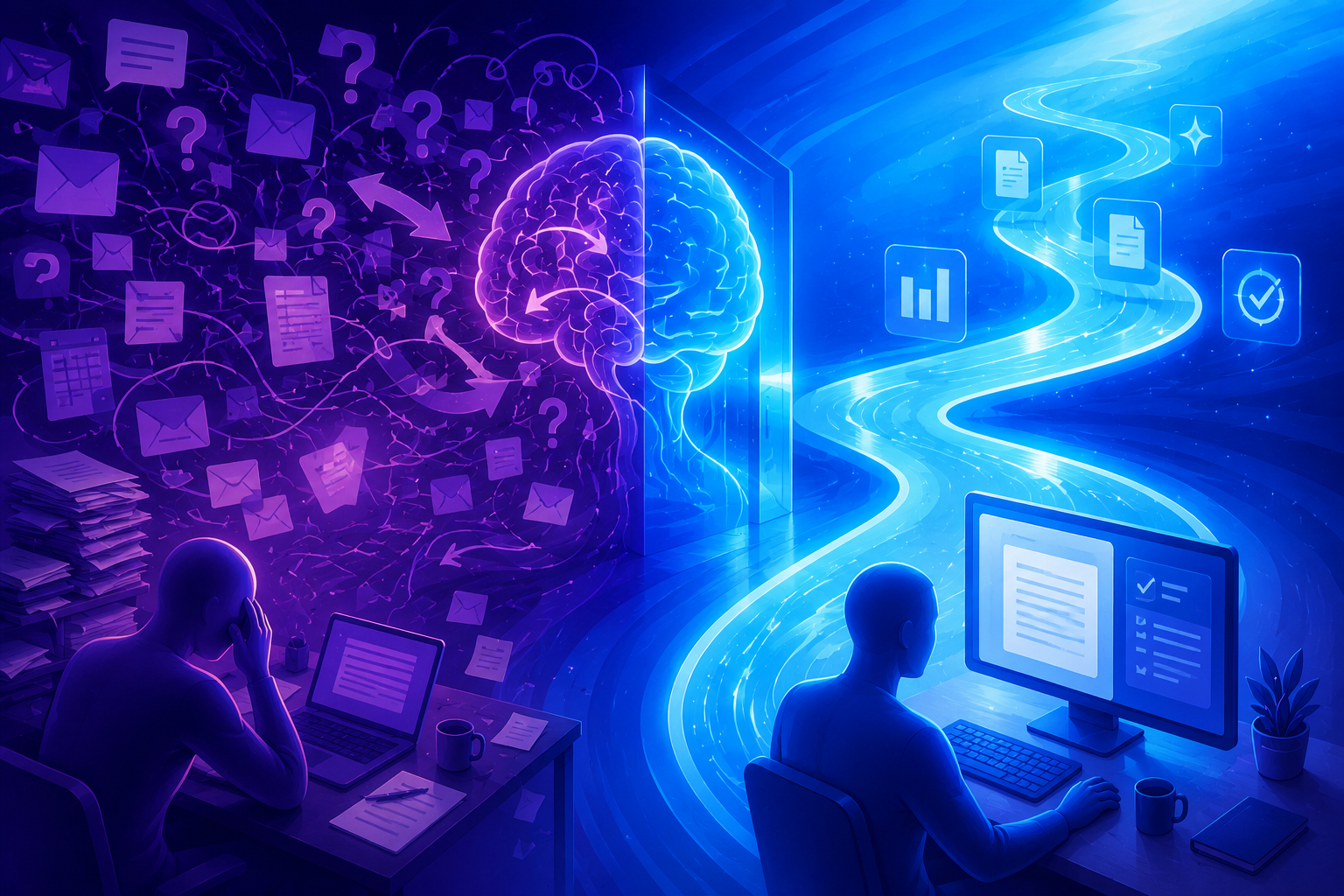 It’s tempting to conclude that people don’t like change, or aren’t willing to learn something new. I don’t think that’s it. The real explanation is less judgmental and more human: our brains are built to conserve mental effort, not physical effort, and definitely not willingness.
That’s an important distinction. This isn’t about whether employees are willing to work hard. It’s about cognitive economy, the brain’s constant, mostly unconscious calculation of whether a task is worth thinking about. The human brain burns roughly twenty percent of the body’s energy while accounting for a small fraction of its weight, so over a long evolutionary timeline we’ve gotten good at spending that energy carefully. We build habits, recognize patterns, and automate repetitive decisions, because thinking deliberately about every action all day would be exhausting.
The workplace runs on the same wiring. Most organizations assume employees are hunting for the most efficient way to get work done. Behavioral science paints a different picture. More often, people default to whatever requires the least immediate mental effort, even when a better option is right next to it. Psychologists sometimes call this being a “cognitive miser.” It isn’t laziness. It’s one of the reasons we stay productive through a day full of constant, low-stakes decisions.
Think about answering a routine email. An experienced employee doesn’t consciously walk through the steps; they read it, draft a reply almost automatically, and move on. Years of repetition turned that into a habit that costs almost nothing.
Now put AI in the middle of it. Should I ask Copilot to draft this? How do I word the prompt? Do I trust what it generated? Do I need to edit it? Did it miss something? Even when AI genuinely reduces the total work involved, it often increases the thinking required just to get started. For a lot of employees, that’s exactly where adoption quietly stalls.
The first interaction is usually the hardest
One of the most persistent misconceptions about AI is that people feel the productivity gain right away. Most don’t. The first several interactions typically feel slower than doing the task themselves. Prompting is unfamiliar, reviewing AI-generated content takes concentration, and verifying accuracy is one more decision layered on top. Organizations tend to measure long-term efficiency while employees are living through short-term friction. Both are true at once, and people make decisions based on what they’re experiencing today, not what they might experience after a month of practice.
Features aren’t the same thing as a workflow
Software companies love demonstrating features. Employees care about finishing their work, and that gap matters more than it gets credit for. A demo might show AI summarizing a meeting in thirty seconds flat. The employee watching is thinking about everything on either side of it: where do I open this, do I need to copy and paste, can it see my notes, how carefully do I check this, how do I share the result. Each question is small on its own. Together, they decide whether the new workflow feels lighter than the old one or heavier.
That’s a big part of why embedding Copilot directly inside Outlook, Word, Teams, Excel, and PowerPoint has mattered. Employees aren’t being asked to learn a new destination. The less someone has to think about where or how to use AI, the more likely they are to actually use it.
Every decision has a cost, even a small one
We tend to talk about AI in terms of the work it removes. Less attention goes to the decisions it adds along the way, and every time someone pauses to decide whether AI should help with a task, they’re spending cognitive energy. Multiply that across dozens of emails, meetings, and documents in a single day, and the cost adds up fast. Ironically, AI can create more decisions before it starts eliminating any.
The organizations getting this right aren’t telling employees to “use AI whenever it makes sense.” They’re identifying specific, recurring moments where it reliably helps: summarize every meeting, draft the first pass of a status update, organize research notes, outline a presentation. Removing the decision removes most of the load that was sitting in front of it.
Good adoption makes AI disappear
The clearest sign that AI has become part of the job isn’t that people are talking about it constantly. It’s that they’ve stopped thinking about it at all. Nobody proudly announces they used spellcheck. Nobody celebrates saving a file to the cloud instead of a hard drive. Those tools succeeded by fading into the background, and I expect AI will follow the same arc.
The organizations that pull off widespread adoption won’t necessarily have the sharpest models or the biggest budgets. They’ll be the ones that make AI feel like the natural continuation of work instead of an interruption to it, because people aren’t out looking for the smartest tool available. They’re looking for the easiest path to whatever already needs to get done. When AI reduces the thinking required to get started instead of adding to it, adoption stops feeling like change. It just becomes how the work gets done.