
How AI Agents Are Quietly Replacing Traditional Apps
There was a time when using AI meant having a polite little chat with a single model, like GPT-3.5 or Claude. You’d type in a question, get one answer, and call it a day. That era—the solo chatbot era—is already fading.
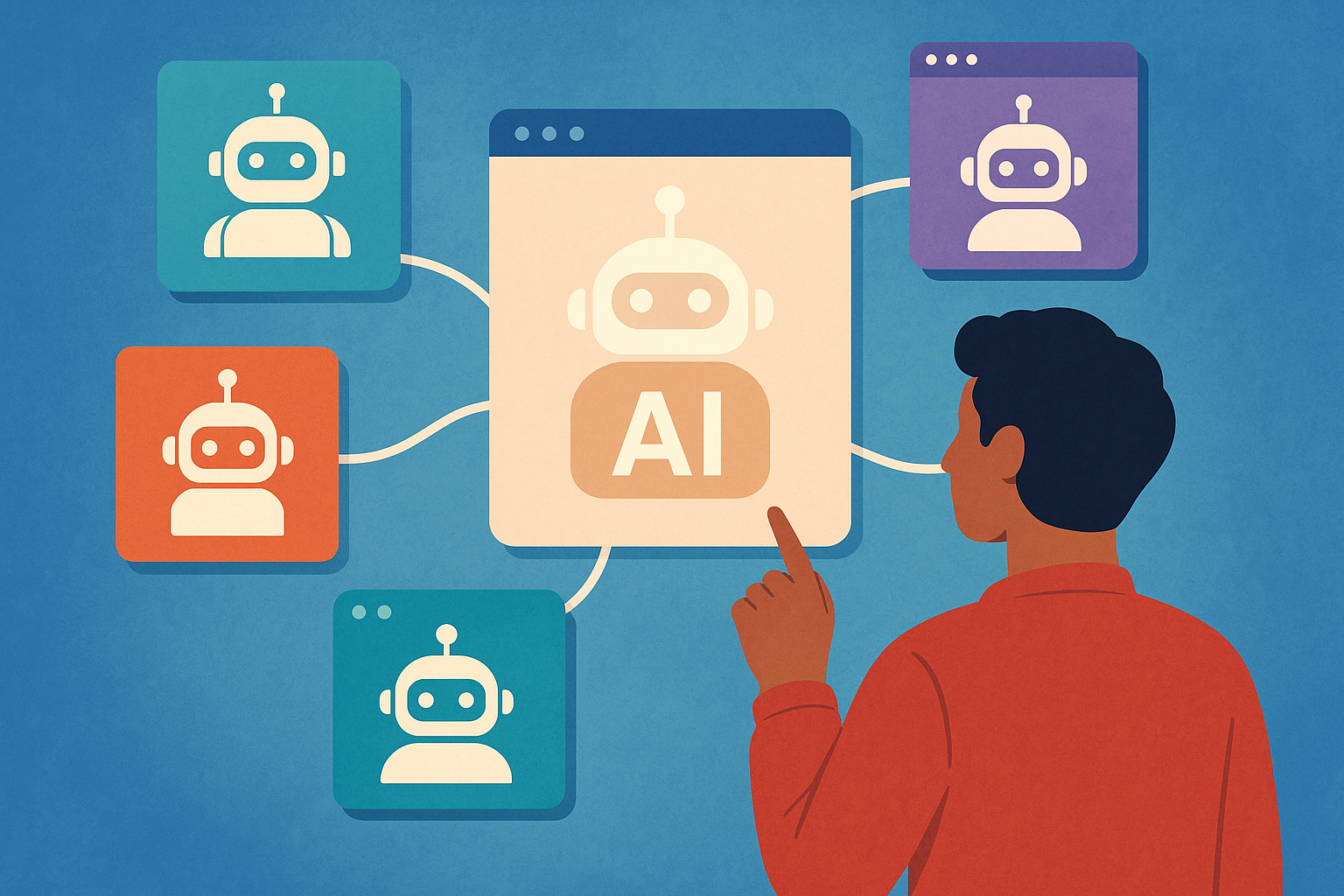 Now we’re entering a new phase: multi-agent AI systems. Think of them as virtual teams, each member with a distinct role, personality, and purpose. Instead of relying on one model to do everything reasonably well, you’re getting a panel of experts. And your apps are about to reflect that.
Thinking Like a Team
Relying on a single AI model is like hiring one person to run an entire company. Sure, GPT-5 can write copy, code an app, answer legal questions, and help you brainstorm names for your startup. But should it? You wouldn’t ask your accountant to design your logo or your lawyer to manage your CRM. So why are we asking general-purpose AIs to do everything?
This is the limitation of one-model thinking. It doesn’t scale. It doesn’t specialize. And it doesn’t mirror how we actually work.
AI agents change that. They’re purpose-driven, context-aware digital personas. Each one has a role, a perspective, and access to tools or models tailored to their expertise. One agent might act as a Chief Marketing Officer, offering brand insights. Another could play the role of a CTO, evaluating your tech stack. A third might be your legal advisor, weighing compliance risk.
These agents aren’t just chatbots with job titles. They’re part of a coordinated system. And that system is smarter, more flexible, and more useful than asking one model to know everything.
The Palmolive Moment
I know this dates me, but it reminds me of those old Palmolive dish soap commercials—where Madge the manicurist would casually tell customers, “You’re soaking in it,” as they unknowingly had their hands in a bowl of the green stuff to soften their cuticles. I use that line all the time when talking about AI, because we’re in a similar moment. The shift to multi-model AI is already happening. Most people just don’t realize they’re soaking in it yet.
Specialized agents are better at handling domain-specific tasks. They help users offload cognitive effort by holding context and focusing on specific problems. And when agents work together, they bring multiple perspectives to a single question, leading to better outcomes.
There are already tools out in the world doing this. For example, Axiom.Industries has built a virtual advisory board made up of AI agents that simulate a real C-suite. Each agent chimes in only when relevant, often powered by different models behind the scenes. In open source, tools like AutoGPT and CrewAI are letting users assign tasks to multiple agents that work semi-independently. Anthropic’s Projects and OpenAI’s Custom GPTs are taking early steps toward building agent ecosystems where each persona has memory and focus. Microsoft’s Copilot stack is also getting there, embedding role-specific intelligence across the Office suite.
This evolution changes what an app is. Instead of being a portal into one big language model, the app becomes a host for many smaller minds. Your productivity tool might have a writing agent running on GPT-4o, a reasoning agent backed by GPT-5, and a visual design agent based on a fine-tuned open model. The interface may start to resemble a conversation thread or a Slack channel, with different agents contributing when their voice is needed.
What This Means, and Where It’s Going
All of this pushes AI into the realm of infrastructure. Just like cloud computing moved from all-in-one apps to modular services, AI is becoming composable. Users will be able to pick bundles of agents—maybe a Startup Stack or an Enterprise Ops suite—then add extras like legal or healthcare specialists. Pricing models could follow streaming services, with flat rates for general use and metered access to premium agents.
For businesses building with AI, this means thinking modular from the start. Can your product support multiple agent roles? Does your interface accommodate a team dynamic? Can your backend route tasks intelligently based on user intent?
For people using AI, it means learning to think like a manager. You’re no longer talking to a single assistant. You’re leading a team. When a problem comes up, ask yourself who on the team should handle it—even if your team is virtual.
This is the big shift. AI is no longer one voice. It’s a roomful of them. And when they work well together, the result isn’t just a better answer. It’s better thinking.
Welcome to the age of AI teams.