
AI Is Coming for Your Job. Maybe.
After a couple of years of running AI adoption workshops and listening to customer fears and excitement about the changes happening within the tech sector, it’s still interesting to hear from the pundits and experts on what they think the rise of artificial intelligence actually means for the future of work. Case in point: a recent piece claims that the creators of ChatGPT say AI may soon replace certain jobs entirely. But the real story isn’t about a few isolated job titles — it’s about entire categories of work and types of tasks being reshaped.
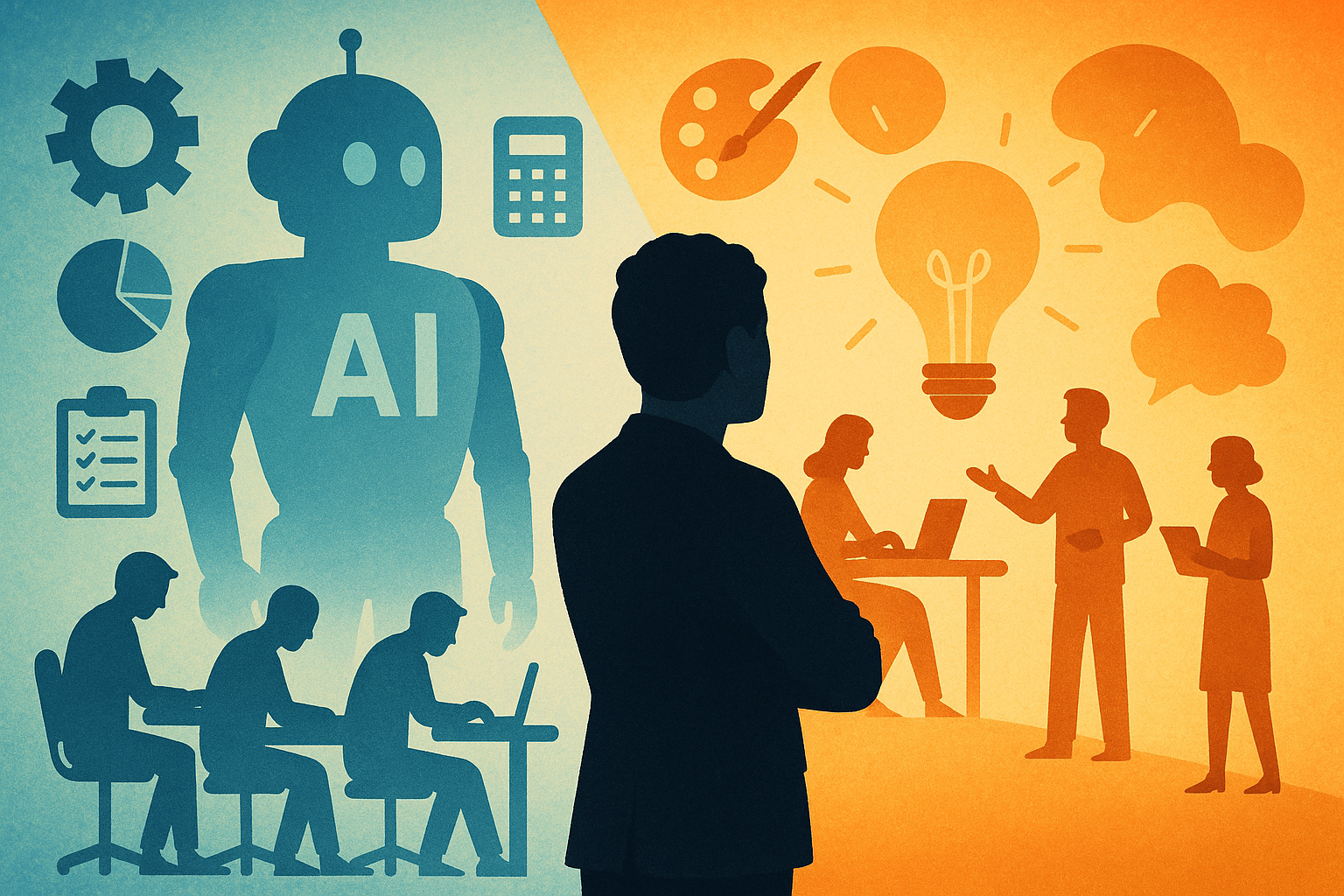 By looking beyond just the headlines, we can see patterns emerging: there are roles that are already weak in the face of AI’s advance, and roles that look far more resilient. So I thought I’d share some data and some personal thoughts on the topic.
Are we on the verge?
The recent article claims that according to Sam Altman, CEO of OpenAI, three professions are “on the verge” of being overtaken by intelligent systems. The implication is that as AI improves, tasks once thought to require human intelligence are now being effectively handled by machines.
That piece reflects a larger trend: AI systems are increasingly capable of matching (or sometimes exceeding) humans at tasks that are repetitive, data-driven, or routine.
But instead of obsessing over exactly which “three jobs” will go first, I think a more useful view is to zoom out and examine the kinds of functional categories that are under pressure.
What Other Reporting and Research Says
First, data-heavy, rule-driven jobs are most vulnerable. A recent analysis by the World Economic Forum finds that industries and jobs in which workers deal with large volumes of data, structured information, or repetitive tasks are the most prone to automation via AI.
That includes roles in finance, accounting, data processing, administrative and clerical functions, and other business-service occupations.
For example, an article from CBS News last August summarizing recent findings shows that accounting, auditing, secretarial work, administrative support, and computer-oriented work are among those facing steep decline as AI adoption rises.
It’s not just white-collar office jobs. Any role that largely involves structured, predictable tasks — even in sectors outside “tech” — is at risk.
Second, early-career and entry-level roles are already being hit harder. Some of the most dramatic changes are happening for younger, less-experienced workers. That same CBS News report mentions a recent study that found that early-career employees in the most AI-exposed fields saw a 13% drop in employment since 2022, while older, more experienced workers in the same fields did not see similar declines.
That suggests AI is not simply replacing all jobs equally; it’s replacing the routine, entry-level layers first, often before those who’ve already built-up experience, intuition, or “tacit knowledge.”
However, the third finding is that not all work disappears. Some gets transformed. Importantly, many experts predict not wholesale elimination of jobs, but transformation. According to a 2025 study by UNRIC, the likely outcome is a rearrangement: some tasks within roles will be automated, others will shift. In many cases, AI is a complement rather than a direct substitute, enabling humans to work faster or smarter, rather than simply replacing them.
In that view, entire occupations don’t vanish overnight. Instead, we see hybrid jobs: humans working alongside AI, shifting from execution to oversight, decision-making, or human-centered tasks. You can read more of this in a study by McKinsey.
What These Patterns Mean for the Future of Work
Looking across these analyses, some clear patterns emerge.
Roles most at risk (or already unstable):
- Jobs heavy on data, routine administrative tasks, processing structured information — think accounting, auditing, clerical or secretarial support, data entry, basic programming or code maintenance, bookkeeping, routine content creation.
- Entry-level positions or early-career roles that rely heavily on repetition or standard procedures.
- Any function where success depends on following fixed rules, templates, or predictable patterns.
Roles likely to remain stable, or even grow:
- Jobs requiring human judgment, complex decision-making, empathy, social intelligence, and interpersonal skills — for example, sectors like healthcare, education, care work, mental health, therapy. These fields are harder for AI to replicate because they rely on human understanding, empathy, moral judgment, and managing unpredictable situations.
- Roles that demand creativity, innovation, original thought, or improvisation — fields where rigid rules don’t apply and nuance matters. This may include ideation, design, artistic work, strategy, leadership, and complex problem-solving.
- Work that blends technical understanding with human oversight — particularly jobs working with or managing AI tools; jobs requiring curation, interpretation, ethics-oriented tasks, human-centered coordination, soft skills and adaptability.
How to Prepare
If I were giving advice to readers, I’d highlight a few practical take-aways based on what we’re seeing now:
- Don’t think in terms of titles — think in terms of tasks and functions. A “job” may survive only if the tasks at its core resist automation. Roles built around predictable, repetitive tasks are more vulnerable than roles built around judgment, empathy, artistry, or unpredictable complexity.
- For early-career workers and those in predictable, data-heavy jobs — start planning now. If your work mainly involves routine administrative, data-processing, or repetitive content tasks, it’s wise to consider shifting toward skills that are harder to automate (creative thinking, complex coordination, human interaction).
- Embrace skills that complement AI, not compete with it. Digital literacy, adaptability, critical thinking, communication, leadership, emotional intelligence — those are increasingly valuable. Even non-technical jobs benefit from being able to use AI tools effectively.
- Consider transitioning into roles where human judgment and human-centric skills matter. Healthcare, education, counselling, creative roles, strategic planning, or roles that involve flexibility and real-world complexity will likely remain more resilient.
- Stay flexible — AI won’t replace all jobs wholesale. Many jobs will evolve. Some tasks might be automated, but new hybrid roles will emerge. People who adapt to working with AI — rather than resisting it — may find themselves at an advantage.
Articles like the one about ChatGPT often focus on specific “jobs” threatened by AI. But if we stop at the job title, we risk missing the larger picture. What really matters isn’t whether a role is called “accountant” or “writer,” but whether the tasks that define that role are automatable.
By focusing on types of functions rather than job labels, you can offer your readers more durable, long-term guidance.
AI is not just another new technology. It’s transforming the very nature of work. For many workers, that shift is already happening. But for others, especially those who cultivate human-oriented, creative, flexible, and judgment-driven skills, the coming era may not bring disruption so much as opportunity.
The future won’t be defined solely by what AI can do but by what humans decide we value most.
- ChatGPT creators just revealed the 44 jobs most at risk of being replaced by AI (LadBible). Includes stats on “win rates” on tasks versus humans for common roles/jobs.
- Is Your Job AI-Proof? What to Know About AI Taking Over Jobs (BuiltIn). A balanced view of jobs going away, jobs that are AI-proof, and jobs that will be newly created by AI.
- AI isn’t replacing jobs. AI spending is (FastCompany). Another perspective I didn’t even touch on, which is how much of the hype is being driven by spending on AI versus value achieved.