
Why AI Sometimes Gets It Wrong
A few days ago, I found myself in a familiar place: an online argument.
 Someone had shared an AI-generated response as proof that they were right. The answer was polished, confident, and neatly aligned with their position. The problem was that it was built on an incomplete set of facts. Key context had been left out.
So I did what seemed reasonable. I provided additional information and asked the AI the same question again, this time with proper grounding. The answer changed. It became more nuanced. Some assumptions were corrected. A few confident claims softened into conditional ones.
That’s when the conversation went sideways. The other person got angry and accused me of manipulating the algorithm.
That reaction stuck with me, because it reveals a growing misunderstanding about how AI actually works. Many people still believe that AI outputs are objective truths, and that changing the input is somehow cheating. In reality, the opposite is true. Providing better context is not manipulation. It is responsible use.
To understand why, you need to understand what AI is actually doing when it responds.
AI is not thinking. It is predicting.
When an AI model generates an answer, it is not evaluating facts or reasoning from first principles. It is predicting the next most likely word based on patterns it learned during training. Every sentence is assembled because it looks like other sentences that came before it. The model does not know whether something is true. It knows whether something sounds right.
This is why AI can be so persuasive even when it is wrong. It has learned how correct answers usually sound. If an incorrect idea has been repeated often enough in well-written sources, the model may reproduce it confidently. Not because it is lying, but because confidence is part of the pattern.
What complicates this further is that AI does not like to stop. Humans are comfortable saying, “I don’t know” or “I’d need to look that up.” AI is not wired that way. When information is missing or ambiguous, it fills in the gaps. It extrapolates. It blends similar concepts. It makes reasonable-sounding guesses (I like to call them “guestimates”) and keeps going.
That is where hallucinations come from. Not malice. Not intent. Just an overly helpful system doing exactly what it was trained to do.
Context plays a massive role in this behavior. If your prompt is vague, the model has to choose an interpretation. It does not choose based on what you meant. It chooses based on what is statistically common. You might be asking about enterprise-scale governance or a specific product capability, while the model quietly answers a more generic, blog-level version of the question. Same words. Very different assumptions.
There is also the issue of time. AI models are trained on snapshots of the past. They do not inherently know what has been deprecated, renamed, or rethought. Without guidance, they may blend old best practices with new capabilities and present the result as a single, confident answer. It sounds coherent, but it may not reflect reality.
This is where many people decide that AI is unreliable.
That conclusion misses the point.
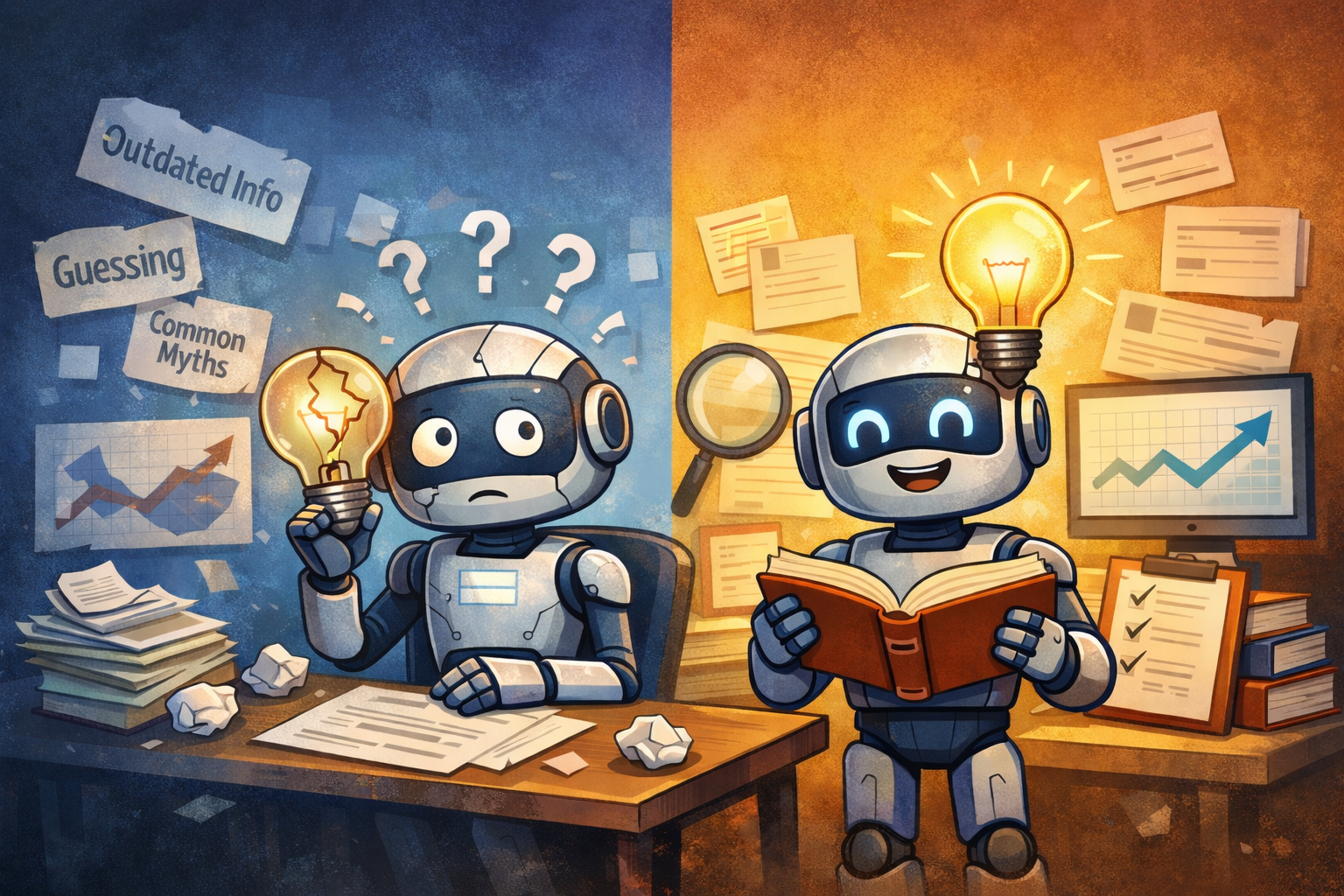
AI is ungrounded unless you ground it.
The moment you provide a source, whether that is documentation, an article, a dataset, or even a short excerpt, you fundamentally change how the model responds. You are no longer asking it to guess what a good answer looks like. You are asking it to reason from something concrete.
That source becomes an anchor. The model prioritizes it over its general training patterns. It reduces improvisation and aligns its response to the material you provided. This is why adding context often changes an answer. You did not manipulate the system. You gave it something real to work with.
When you add a second source, the response often becomes more careful. The model now has to compare. It has to reconcile differences. It has to soften claims when certainty is not justified. You will often see fewer absolute statements and more conditional language. That is not a flaw. That is the model behaving more responsibly.
What is especially important here is that sources do not just improve accuracy. They improve reasoning. Grounded prompts lead to clearer logic, stronger explanations, and far less hand-waving. You are not just correcting what the model says. You are improving how it thinks through the problem.
This is why follow-up prompts matter so much. When you add context, constraints, or documentation, you are not fixing the AI. You are guiding it. You are telling it what matters and which assumptions are no longer acceptable.
This is also why the accusation of manipulation misses the mark.
Leaving out relevant information is not neutral. It is a choice. Presenting an AI response without context and treating it as objective truth is far more misleading than refining a prompt with better grounding. If anything, refusing to provide sources is what introduces bias.
The better mental model is to treat AI like a very capable intern. A fast one. A tireless one. But still an intern.
A good intern needs context. They need references. They need clarity around scope and expectations. If you give them vague instructions, you may get something that looks impressive but falls apart under scrutiny. If you give them proper sources and constraints, you get work that is thoughtful, grounded, and genuinely useful.
AI already has confidence. What it needs is grounding.
And when you provide that, the quality of the output changes dramatically. Not just fewer errors, but better thinking, better explanations, and better decisions.
That is the difference between using AI casually and using it well.