
Why “Doing More with Less” Has Become the Default Mandate for IT
Somewhere along the way, “do more with less” stopped being a temporary rallying cry and quietly became the permanent job description for IT.
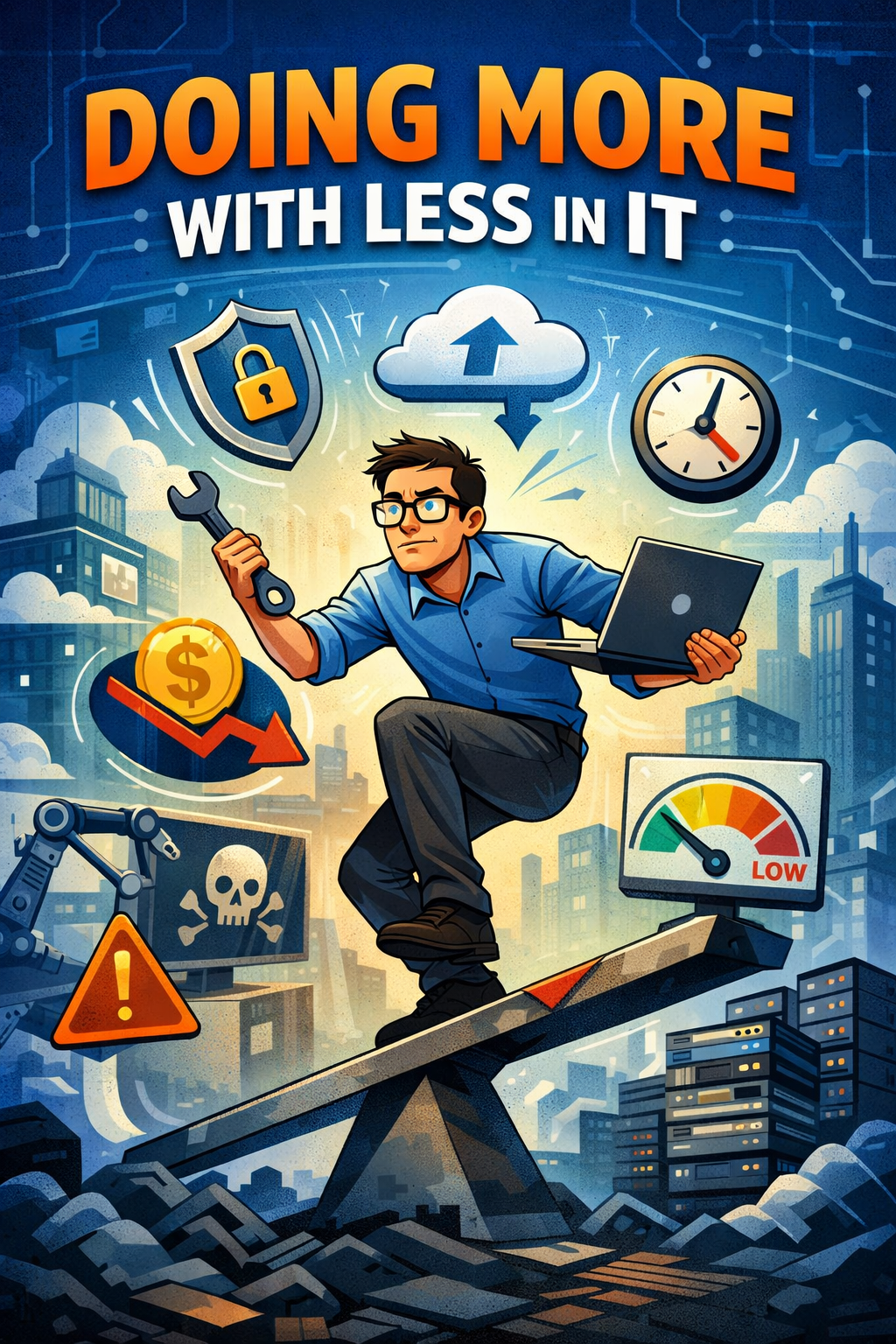 It’s not just that budgets are tight, though they usually are. It’s not just that everyone expects technology to work flawlessly all the time, which they absolutely do. It’s that IT has become the backbone of nearly every business function while still being treated, in many organizations, like a cost center that should shrink year over year.
That combination creates a very specific kind of pressure. IT is expected to deliver more reliability, more security, more enablement, more innovation, and more speed, all while consuming fewer dollars, fewer people, and fewer hours.
So how did we get here? And why does it feel like there’s no way back?
IT Is Now Supporting “Work,” Not Just Systems
In a modern organization, almost every meaningful activity depends on a web of systems that IT influences, owns, secures, or at the very least gets blamed for when they break. Sales relies on CRM and analytics. Marketing lives inside automation platforms and content systems. Finance depends on integrated data and controls. HR runs on digital workflows and identity management. Operations need uptime, device compliance, and systems that scale without drama.
Layered on top of all of that is the modern reality of work itself. Distributed teams. Multiple devices. Collaboration platforms. A constant flow of information that never really turns off.
Which means IT is no longer supporting a single office or a handful of systems. IT is supporting “work” as a concept.
When everything is digital, IT becomes the nervous system of the organization. And nervous systems do not get weekends.
At the same time, budget scrutiny has shifted from cyclical to permanent. Even when organizations continue investing in technology, the conversation has changed. Spending is rarely framed around what’s possible. It’s framed around what’s justified.
IT leaders are expected to show ROI, reduce redundancy, consolidate tools, and tie every decision to a measurable business outcome. Purchases face more questions, more approvals, and more pressure to prove value quickly. None of that is inherently bad. In fact, it’s healthy when technology decisions are aligned to business strategy.
The problem is that many organizations expect IT to operate like a growth engine while funding it like a maintenance department.
When budgets don’t grow, efficiency becomes the only lever left to pull. “Do more with less” stops being a slogan and starts being a survival strategy.
The Pressure Keeps Compounding
Security only amplifies that pressure. What used to be a major responsibility is now a daily siege. Ransomware, phishing, identity attacks, supply chain risks, and regulatory complexity have turned security into a constant state of readiness.
IT teams are expected to strengthen defenses continuously, not just with policy and training, but with modern architectures like zero trust, hardware-based authentication, and cloud workload protection. All of that is necessary. None of it is free.
Stronger security means more monitoring, more configuration, more incident response planning, and more governance. When expectations rise faster than staffing or budget, IT has little choice but to automate aggressively, standardize ruthlessly, and eliminate anything that does not clearly earn its keep.
Meanwhile, cloud and digital transformation are no longer “projects.” Cloud computing was once a strategic initiative. Now it’s table stakes.
Even organizations with significant on-premises infrastructure rely heavily on cloud services for identity, collaboration, management, backup, analytics, and increasingly, AI. The cloud is no longer a destination. It’s the environment IT operates in, whether they planned for it or not.
That shifts the workload in two important ways. Modernization becomes continuous, because legacy systems do not magically improve on their own. And change management becomes constant, because every new platform, policy, or workflow affects real people trying to get real work done.
IT now has to be deeply technical and increasingly human-centered at the same time. Implement change without disruption. Drive adoption without breaking operations. That’s a tall order, especially when teams are already stretched thin.
Talent shortages only tighten the vise. The demand for skilled IT professionals remains intense. Hiring is expensive, competitive, and slow. Retention requires more than salary. It requires growth opportunities, flexibility, learning, and a culture that does not grind people down.
Here’s the trap. When teams are under-resourced, the people who remain carry more load. More tickets. More projects. More context switching. More on-call hours. More “can you just” requests. That leads to burnout. Burnout leads to attrition. Attrition makes the resource problem worse.
In that environment, efficiency is not just a financial goal. It becomes a team health strategy. Sometimes doing more with less is the only way to keep your best people from walking out the door.
And then there’s the final twist. IT is not only expected to become more efficient itself. It is expected to make everyone else more efficient, too.
When leaders talk about productivity gains, they usually mean better collaboration, faster access to information, less manual work, automated processes, more reliable tools, and better decision-making through data. Nearly all of that depends on IT architecture, governance, enablement, and execution.
So IT ends up carrying two mandates at once: run the digital foundation with fewer resources, and help the entire organization get more productive on top of that foundation.
That’s why the pressure feels constant. Because it is.
What the Mandate Really Means
“Do more with less” sounds blunt, but in practice it becomes a discipline.
It forces IT leaders to standardize and simplify, consolidate tools, reduce overlap, automate repetitive work, and prioritize platforms that are secure, resilient, and easier to manage. It pushes investment toward training so teams can handle more complexity with confidence.
The mandate is not really about doing more work.
It’s about creating systems, processes, and teams that can produce more outcomes with fewer moving parts.
That’s the reality of modern IT. Organizational dependence on technology keeps growing. Expectations keep rising. Threats keep evolving. Resources rarely scale at the same pace.
So “do more with less” becomes the default mandate not because anyone loves it, but because IT has become the engine room of the business, and the business is asking it to run faster, smoother, and safer without adding more fuel.
Welcome to the modern IT job description.