The Slow Disappearance of Shared Thinking
I used to recognize the moment collaboration actually started.
It was messy. Someone would say something half right. Someone else would misunderstand it. A third person would push back, not because they disagreed, but because they were still trying to understand what the idea even was. The room would warm up. Pens came out. A box was drawn around the third of the whiteboard filled with notes from the last meeting, protecting it from what would come next. Ideas were scribbled on the board. Voices overlapped. The idea would change shape in public.
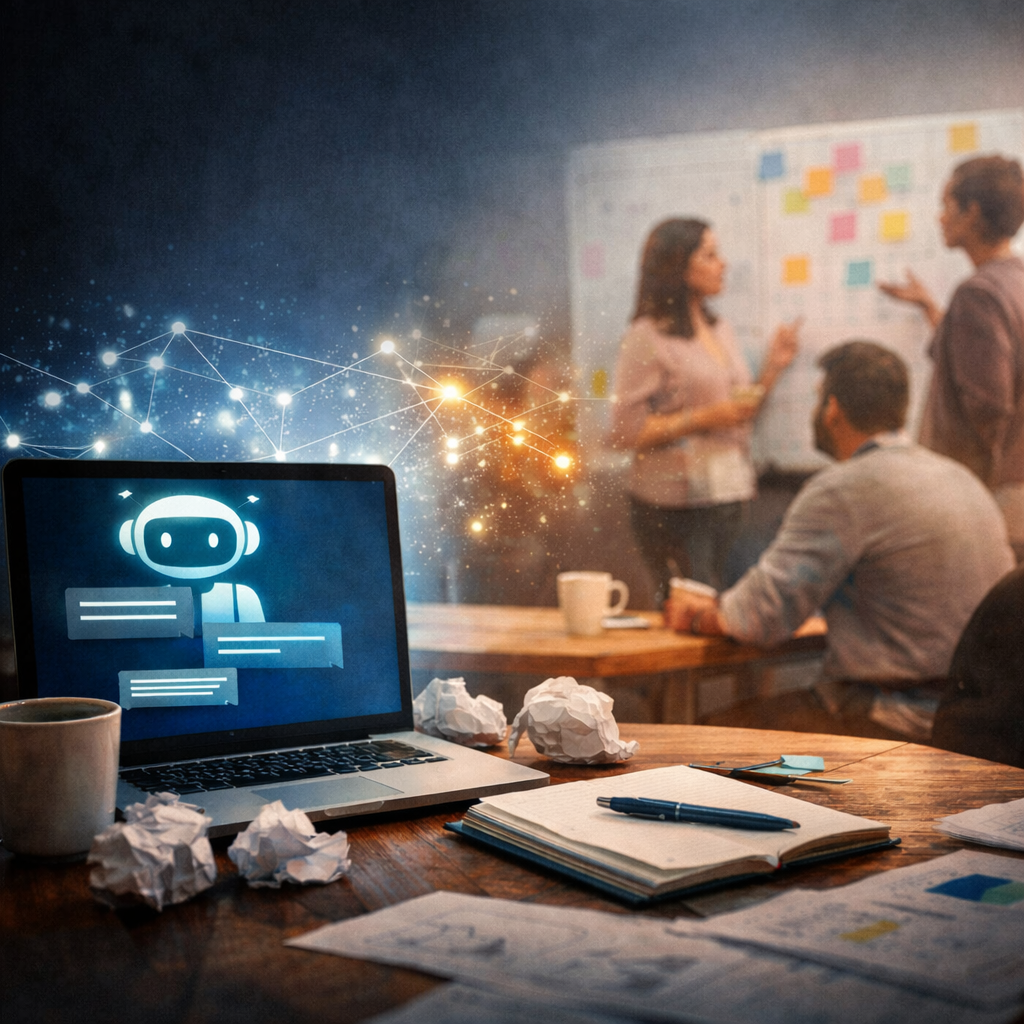 That moment still exists, technically. We still have meetings. We still say we are brainstorming. But something has shifted underneath it all, and I do not think we are talking about it honestly enough.
AI has become the first place we test ideas. Not as a tool we bring into the room, but as a private space we go to before the room ever exists. And that changes the culture of collaboration more than any new software ever has.
This is not about the technology. It is about what happens to people when the first draft no longer belongs to the group.
From brainstorming together to refining alone
Most ideas used to enter the room in an unfinished state. They were fragile. Awkward. Sometimes wrong. That was the point.
Now ideas often arrive already shaped, already articulated, already defended. Not because the person presenting them has done deeper thinking, but because they have pre-processed the idea through a system designed to make things sound coherent and reasonable. There are a lot of reasons to love this. More people providing inputs and ideas. More perspectives being shared. But a major downside is that the rough edges get sanded down before anyone else ever touches them.
What we call collaboration increasingly looks like refinement, not creation. We are editing instead of inventing. Reacting instead of co-building.
That subtle shift matters. When an idea shows up polished, it carries more weight than it deserves. It feels further along than it actually is. People hesitate to challenge it, not because it is better, but because it appears finished. The room becomes quieter, not more efficient. It reminds me of my second year as an industrial design student. One of my fellow students was not a great designer (neither was I, to be fair) but he worked at a print shop and his framing, matting, and presentation skills were impeccable. The problem was that most of the class, and the teacher, often looked past the weaknesses in his designs because of the quality of his presentations.
I see this especially in fast-moving teams where attention spans are already stretched thin. Good enough wins. Tested and confirmed feels optional. We move from draft to done without ever really thinking together.
Why fewer raw ideas show up in meetings
There is another change I keep noticing. Fewer raw ideas show up at all.
If AI is where you go to sanity-check your thinking, then by the time you talk to another human, you are no longer asking, “Is this something?” You are asking, “Can you approve this?” That is a very different posture.
Peer review starts to disappear, not because people do not care, but because the social risk calculus has changed. Why bring an unfinished thought into a meeting when you can pressure-test it privately first? Why expose uncertainty when you can arrive with confidence on demand?
The problem is that confidence is not the same thing as insight. And clarity generated in isolation is often thinner than clarity forged through friction.
When we skip the awkward middle, we lose something essential. We lose the chance for ideas to be reshaped by perspectives that were never in the original prompt. We lose the accidental brilliance that comes from misunderstanding each other and working through it. We lose the shared ownership that makes teams actually feel like teams.
The impact on quieter voices and the risk of not learning
This shift does not affect everyone equally.
Quieter voices and junior staff often feel it first. When ideas arrive pre-packaged, there is less room to enter the conversation sideways. Less space to ask naïve questions or think out loud. If you are still learning, the bar suddenly feels higher, even though it should not be.
There is also a deeper fear underneath all of this, one that I cannot shake. I worry that people are not learning anymore. They are leaning.
When AI becomes the place where thinking starts, it can quietly replace the struggle that builds judgment. You still get answers. You still get language. But you skip the mental work that teaches you how ideas actually form, where they break, and why they matter. Over time, that changes who grows. And it changes who leads.
Collaboration is how we used to learn in public. How we tested our instincts against other minds. How we figured out what we did not yet know. When that process disappears, teams may still move fast, but they move shallow.
That is why collaboration now has to be intentional. It cannot be assumed. It cannot be left to chance. People and teams have to actively make space for unfinished thinking again.
That might mean leaders rewarding questions instead of polish. It might mean meetings where raw ideas are explicitly welcomed and early drafts are expected to be human, not optimized. It might mean saying out loud, “Do not bring me the answer yet. Bring me the thinking.”
AI will keep getting better at producing first drafts. That is not the threat. The real risk is letting those drafts replace the collective work of shaping ideas together.
Collaboration is not inefficiency to be smoothed away. It is how trust forms. It is how judgment develops. It is how people learn to think, not just respond.
If we want teams that are resilient, creative, and genuinely smart, we cannot outsource the messy middle. We have to protect it. And more than that, we have to choose it.