
The Proof-of-Concept Trap
Deloitte’s 2026 State of AI in the Enterprise report has a section I keep coming back to. They call it “the proof-of-concept trap,” and they describe it this way: organizations that experiment with AI often see positive results in controlled conditions but cannot consistently predict which use cases will yield the highest return on investment. That lack of clear value realization creates a vicious cycle where companies continue funding new pilots — which are relatively low cost and lower risk — rather than facing the harder work of scaling up existing successes.
A healthcare AI leader they interviewed put it more plainly:
“If there is no coherent AI strategy in organizations, you are likely to see pilot fatigue. You’re chasing the next shiny object, pressured to do something with AI without a real plan. I’ve seen many instances where people embark on pilots, but when asked how they’ll scale up if successful, they often don’t have an answer.”
I’ve been watching this exact pattern play out for 35 years. The names change — it was ERP in the 90s, SharePoint in the aughts, cloud migration throughout the 2010s, and now AI — but the trap is the same. And the reason organizations keep falling into it has less to do with the technology than with how they set up the experiment in the first place.
The Sandbox Problem
 Here’s what most AI pilots actually look like: a small team, a few months, cleansed data, an isolated environment, and a use case that was selected specifically because it seemed manageable. Low stakes, controlled variables, limited blast radius if something goes wrong. Leadership gets a demo. Everyone applauds. The report gets filed. And then… not much happens.
The Deloitte data makes the scale of this problem visible. Only 25% of organizations have moved 40% or more of their AI experiments into production. Meanwhile, 54% expect to reach that level within the next three to six months. I’ll be curious to see next year’s numbers, because I’d bet a meaningful portion of that 54% doesn’t get there. Not because the technology failed them, but because they’re still running pilots the same way.
The problem isn’t the pilot. The problem is what the pilot is designed to prove.
When you cleanse your data before running a pilot, you’ve already invalidated the results. Real production environments don’t have clean data. They have duplicates, gaps, legacy formatting inconsistencies, and fields that haven’t been updated since 2019. When your AI model performs beautifully on sanitized input and then gets handed actual operational data at scale, it behaves differently. Sometimes dramatically so. You haven’t learned what you needed to learn.
When you select a use case because it’s low-risk and isolated, you’ve removed the very pressures that determine whether a solution will actually be adopted. Real projects have deadlines. They have stakeholders who care about outcomes. They have integration dependencies, legacy system constraints, and people whose jobs are affected by whether this works. Strip all of that out and you’re not running a pilot. Instead, you’re running a science fair project.
Sandbox Conditions Produce Sandbox Results
I’ve seen this pattern across dozens of organizations in technology deployments going back decades, and AI is not special in this regard. The organizations that get the most value from SharePoint aren’t the ones that stood up a pilot portal with sample documents and a few volunteer users. They are the ones that took a real team with a real project — a product launch, a compliance initiative, a client deliverable — and made the platform solve an actual problem under actual pressure.
Same principle applies here. If there’s no urgency around the problem at the center of your pilot, you will not get meaningful data. You’ll get a metrics report that says the model performed well under test conditions, which is essentially the same as saying your car runs fine in a parking lot.
The Deloitte report identifies several downstream symptoms of this: lack of clear ROI metrics, difficulty predicting which use cases will yield value, the vicious cycle of funding new pilots instead of scaling successful ones. These are symptoms. The root cause is that the pilot was never designed to answer the question that matters: does this actually work when it has to?
What a Real Pilot Looks Like
 I’m not suggesting you should recklessly expose your organization to risk in the name of authenticity. What I am suggesting is that “low risk” and “sandboxed” are not the same thing, and most organizations conflate them.
A real pilot has a real problem at its center. Not a hypothetical, not a representative sample, not a use case that was selected because the data was already clean. An actual operational problem that someone in the organization genuinely needs solved, with a timeline and stakeholders who will notice if it doesn’t work.
A real pilot uses real data. Messy, inconsistent, incomplete real data. Because that’s what your AI system is going to encounter when it goes to production, and you need to know now — not six months from now — how it handles that.
A real pilot has real success metrics defined before it starts. Not “the model achieved X% accuracy on the test set,” but “we reduced processing time for this task by Y hours per week” or “we eliminated Z escalations per month.” Business outcomes, not model performance benchmarks.
A real pilot has executive visibility. Not executive cheerleading, but actual attention. Someone whose job is affected by whether this works. Because without that, you’ll never get the organizational support required to move from pilot to production, and the Deloitte data is clear on this point: organizations where senior leadership actively shapes AI initiatives achieve significantly greater business value than those where it’s delegated down.
A real pilot is treated like a real project. That means a project plan, a budget, defined roles, and someone accountable for delivery. Not a skunkworks experiment that exists outside of normal governance and reporting. The moment a pilot is treated as special and separate, you’ve signaled to the organization that it isn’t serious, and people respond accordingly.
The Urgency Gap
There’s one more element that rarely gets discussed, and it’s the one I keep coming back to from my own experience: urgency.
Pilots without urgency produce artificial engagement. People participate when it’s convenient. They report that things are going well because there’s no cost to saying so. Edge cases don’t surface because nobody is pushing hard enough to find them. And the data you collect reflects polite interest, not operational reality.
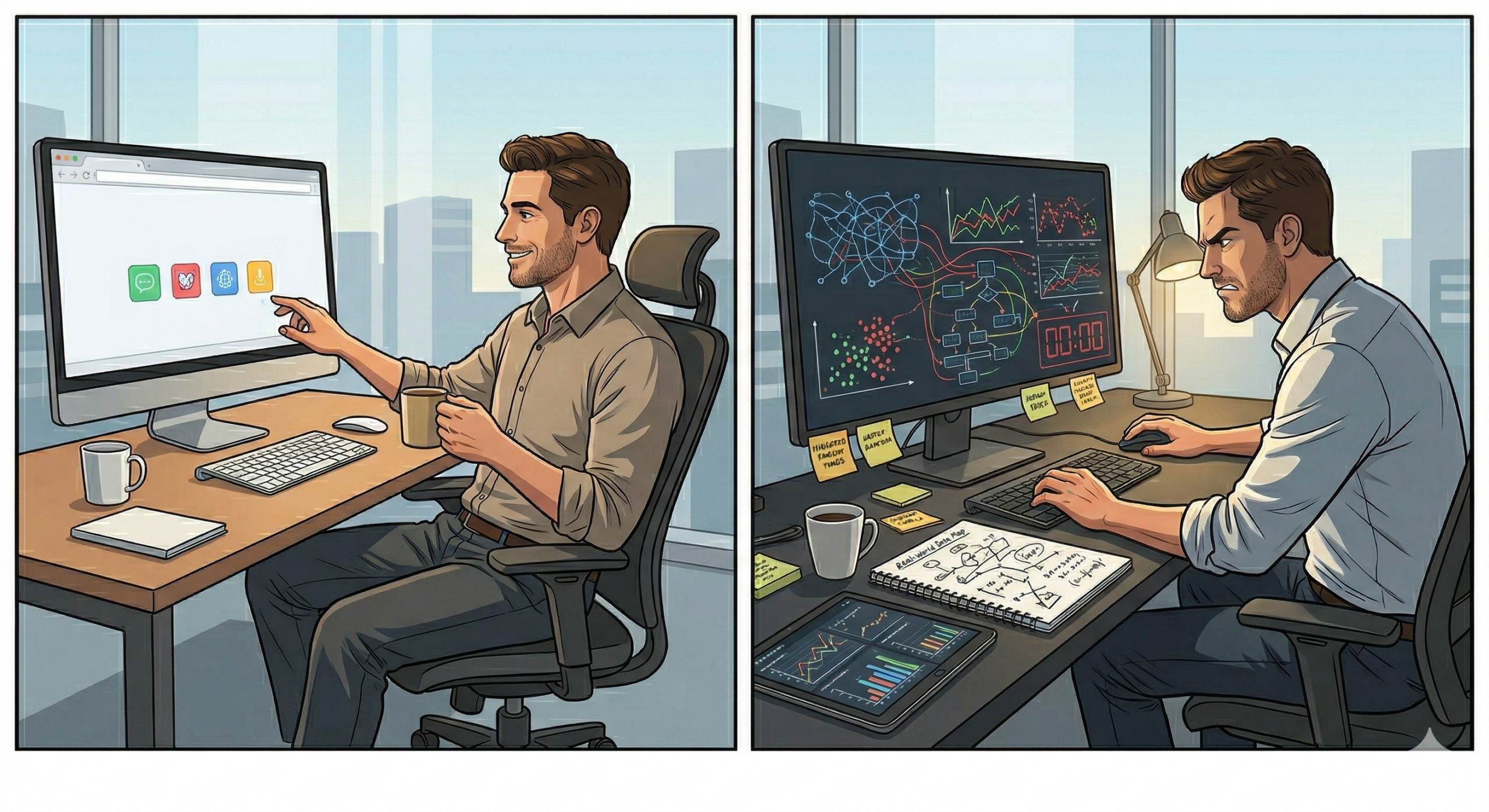 Put that same technology in front of a team that has a real deadline and a real problem, and you’ll learn more in two weeks than you learned in three months of sandbox testing. You’ll find out where the integrations break. You’ll discover the data quality issues nobody mentioned in the requirements phase. You’ll see how users actually behave under pressure, which is almost never how they behave in a demo.
Act serious. Treat it seriously. Get serious results.
The organizations that are actually moving AI from pilot to production — that 25% Deloitte identifies — are almost certainly not doing it by running better sandboxes. They’re doing it by treating AI deployment the way they treat any other strategic technology initiative: with real problems, real stakes, real data, and real accountability.
The Harder Conversation
The proof-of-concept trap persists because it’s comfortable. A sandboxed pilot with cleansed data and a friendly use case is unlikely to fail visibly. It keeps the experiment alive, keeps the options open, and lets everyone feel like progress is being made without actually committing to anything.
That comfort is expensive. The Deloitte report notes that most respondents believe resolving the key challenges for their priority AI initiatives will take more than a year, which they correctly flag as “far too long in today’s fast-moving, hypercompetitive marketplace.” I’d argue that the timeline is driven less by the complexity of the technology than by the organizational habit of treating pilots as ends in themselves rather than as a means to production.
The question worth asking about your AI pilot isn’t “did it work in the test environment?” The question is “are we willing to bet a real project on this?” If the answer is no, you should be asking why, and whether that reason is about genuine risk or about the organizational comfort of keeping things contained.
Because here’s the thing: the proof of concept is supposed to prove something. If it’s not being designed to prove that the solution works under real conditions, what exactly is it proving?