
Why IT Should Lead, Not Block, Self-Service Innovation
Here is a truth that most IT leaders already know but rarely say out loud: your team cannot build every application the business needs. Not this quarter, not next year, not ever. The backlog grows faster than headcount, budgets are flat or shrinking, and every department has at least one critical process still running on a spreadsheet that someone built in 2017 and quietly hopes never breaks.
The instinct in that situation is to tighten control. Lock down what people can build, restrict access to tools, funnel every request through formal intake. It feels responsible. It also guarantees that business teams will route around IT entirely, building shadow solutions on consumer tools with zero governance, zero visibility, and zero security oversight.
There is a better path, and it starts with a shift in how IT defines its role.
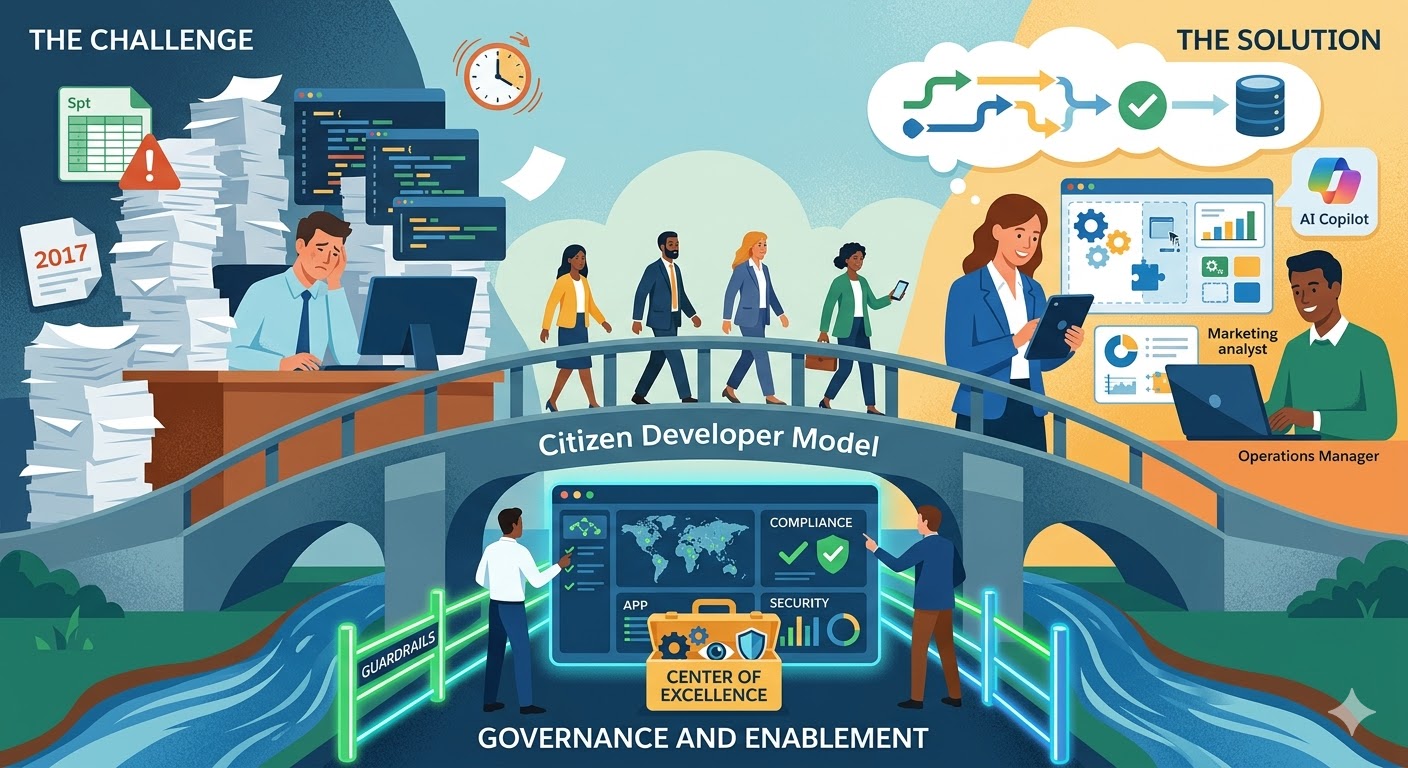
The Citizen Developer Model
The concept of citizen development is not new, but the tooling has finally caught up to the idea. Platforms like Microsoft’s Power Platform now make it realistic for business users with no formal development background to build functional applications, automate workflows, and create dashboards using visual, low-code design tools. These are not toy apps. Organizations are running approval workflows, inspection systems, vendor management processes, and customer-facing portals on solutions built by the people who understand the process best.
The key word there is “people who understand the process best.” When a procurement analyst builds a vendor onboarding app, they are not guessing at requirements. They have lived the pain of chasing documents through email and tracking compliance on a shared spreadsheet. The result is a targeted solution that solves a specific problem, built in days or weeks rather than months, without consuming a single hour of developer time from the IT backlog.
That is not a threat to IT. It is a relief valve.
What Changes for IT
If business users are building apps, what exactly is IT doing? The answer is arguably more important than what IT was doing before.
In a mature citizen developer model, IT shifts from building every solution to governing the platform those solutions run on. That means defining which data sources can be connected to which environments, establishing naming conventions and lifecycle policies, monitoring what gets built and how it scales, and stepping in when a solution outgrows what a citizen developer should reasonably manage.
Microsoft’s Center of Excellence Starter Kit provides a practical framework for exactly this. It gives IT teams visibility into every app, flow, and bot in the tenant, along with usage metrics, maker activity, and compliance status. Managed environments add another layer, letting administrators control which connectors are available, require solution packaging for production apps, and enforce sharing limits. These are real governance tools, not theoretical ones.
The shift is from gatekeeper to guardrail. IT is not approving or denying every request. IT is building the road and painting the lines, then letting the business drive.
AI Is Lowering the Bar Further
The citizen developer model was already accelerating before AI entered the picture. Now, with Copilot integrated into Power Apps, Power Automate, and Power BI, the barrier to entry has dropped again. A business user can describe the app they want in plain language, get a working draft, and refine it visually. Someone who has never written a formula can ask Copilot to generate the logic for conditional visibility or a data validation rule.
This does not eliminate the need for governance. If anything, it increases it. When more people can build more things more quickly, the platform management layer becomes even more critical. But that is precisely the point. IT’s value is not in being the only team that can build apps. IT’s value is in making sure the platform stays healthy, secure, and sustainable as adoption scales.
The Real Risk Is Doing Nothing
Organizations that resist the citizen developer model do not avoid risk. They just shift it somewhere less visible. Business teams will solve their own problems regardless. The question is whether they do it on a governed platform with enterprise security, or on a patchwork of consumer tools and personal accounts that IT cannot see, audit, or protect.
Leading self-service innovation means IT stays at the center of the conversation. Blocking it means IT loses the conversation entirely.
The backlog is not going away. But the way your organization addresses it can change. Give business users the tools and the guardrails they need, and IT gets something it has not had in years: the bandwidth to focus on the work that actually requires a development team.