
Agentic AI Finds Its Body
We spent years waiting for augmented reality to matter. Floating menus, virtual try-ons, Pokémon in the park. Personally, I was looking forward to a reduced-price set of Google glasses that would direct my path with glowing arrows when the location awareness capabilities identified that I was close to a store for which I had a coupon. Alas, that dream has not yet come to fruition. All we got were impressive demos that never quite changed how we worked or lived. The problem wasn’t the display technology. It was that AR had nothing intelligent driving it.
 That’s changing fast, and the implications are bigger than most people realize.
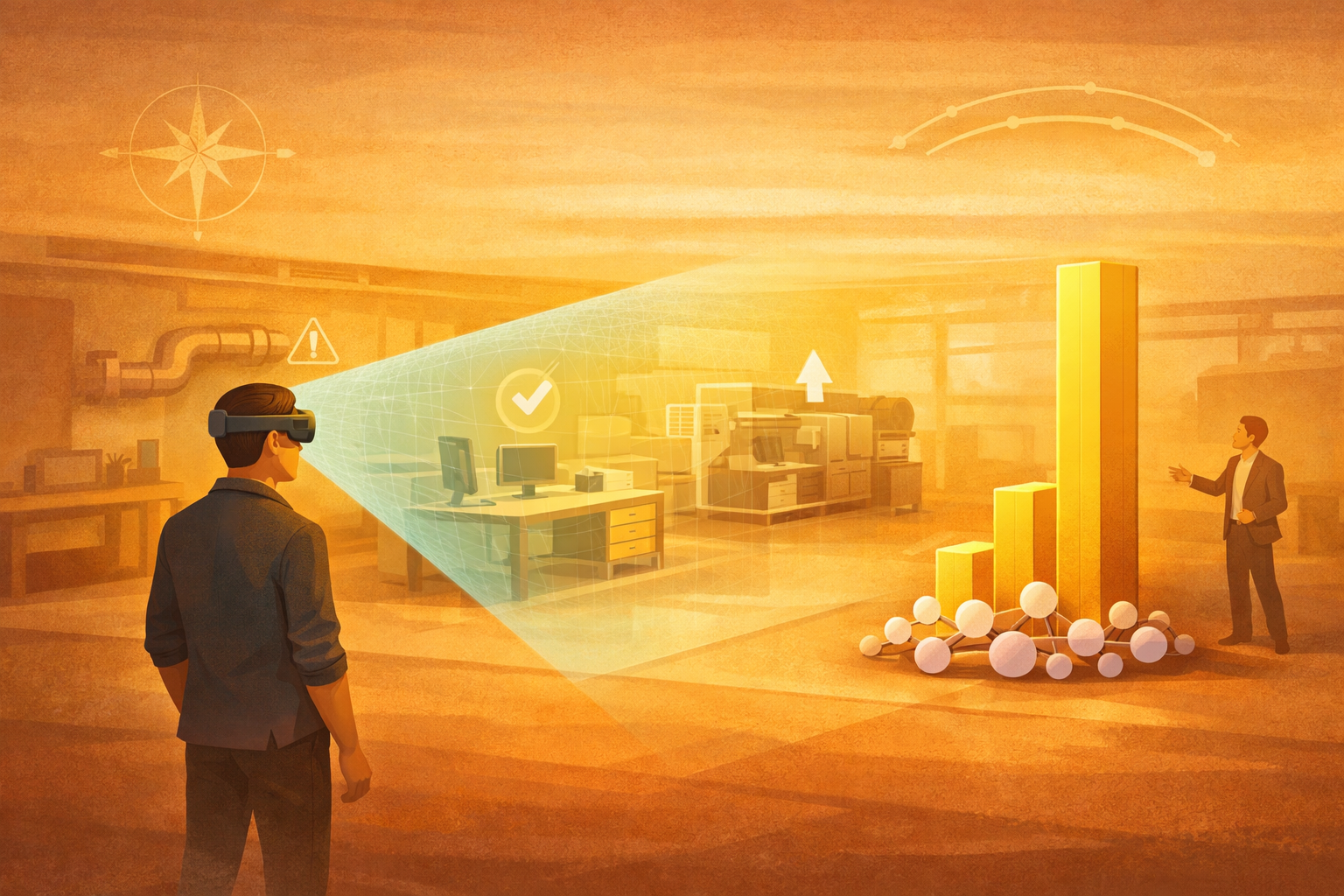
Agentic AI — systems that execute multi-step tasks autonomously, not just generate content — is finding its physical home in AR. The agent supplies intent and autonomy. AR supplies spatial context and presence. Together, they’re becoming something genuinely new: an operating system for the physical world.
Here are three things worth understanding about where this is heading.
Reality is the guardrail.
One of the persistent criticisms of large language models is hallucination: confident output untethered from fact. In a purely text-based environment, the model has nothing to check itself against. In an AR environment, it does. Real-time LiDAR, computer vision, and depth sensors ground the agent in physical reality continuously. It can’t tell you the door is on the left when the sensor data shows otherwise.
This isn’t a minor technical footnote. It’s one of the most important structural advantages of agentic AI operating in spatially-aware environments. The physical world becomes a constant verification layer that no amount of prompt engineering can replicate. Agents embedded in AR will simply be more accurate and more trustworthy than agents operating in the abstract.
The interface is about to go proactive.
Every AR experience you’ve used so far has waited for you. You tap, you ask, you point. The system responds. That interaction model is ending.
Agentic AR is proactive by design. The agent has a goal and pursues it continuously, surfacing information and taking action as conditions warrant, without waiting to be asked. Your glasses detect a slow pipe leak. The agent identifies the part, checks your warranty, cross-references local plumbers, and overlays repair steps in your field of vision. You didn’t ask. It saw a problem and started solving it.
Multiply that across a factory floor, a surgical suite, or a B2B sales environment and the implications compound quickly. Agents are already being deployed to monitor machine vibration and autonomously throttle power before failure occurs, to coordinate surgical instrument preparation in real time, and to negotiate supplier pricing on a buyer’s behalf while they’re still walking the trade show floor. The interface isn’t just getting smarter. It’s getting ahead of you.
Autonomy without accountability is a liability.
The harder conversation is governance. If an agentic AR system is continuously perceiving your environment in order to be useful, it is also continuously recording it. Spatial data about the layout of your home, your facility, your daily patterns is extraordinarily sensitive. Most organizations deploying these systems haven’t fully reckoned with who owns that data or what happens when it’s processed by third-party infrastructure.
Gartner’s 2026 guidance on multi-agent systems adds another layer: as agents become more autonomous, the risk isn’t that they fail. It’s that they succeed in the wrong direction, compounding small errors across long task chains before anyone notices. Kill switches and audit trails need to live inside the AR interface itself, visible and operable by the people working with the agent in the field, not buried in a backend dashboard.
The technology is advancing faster than the governance frameworks designed to support it. That gap is where the real risk lives in 2026.
– – –
The full version of this article goes deeper on the convergence mechanics, industry use cases across manufacturing, healthcare, and B2B retail, and the agent-to-agent collaboration protocols making this possible. Worth the read if you’re thinking seriously about where enterprise AI is heading.