
Two Decades of Watching Social Media Transform
Back in 2004, when I first launched this blog, social media was still experimental. Nobody was talking about creators, algorithms, influencers, engagement rates, or personal brands. We were talking about RSS feeds, forums, blogging platforms, wikis, and whether online communities could fundamentally change how people collaborated and shared information.
At the time, I started writing as a way to track and observe the evolution of these emerging social technologies. What fascinated me was not just the technology itself, but the behavioral shift behind it. Social media was changing how people communicated, learned, collaborated, and built trust online.
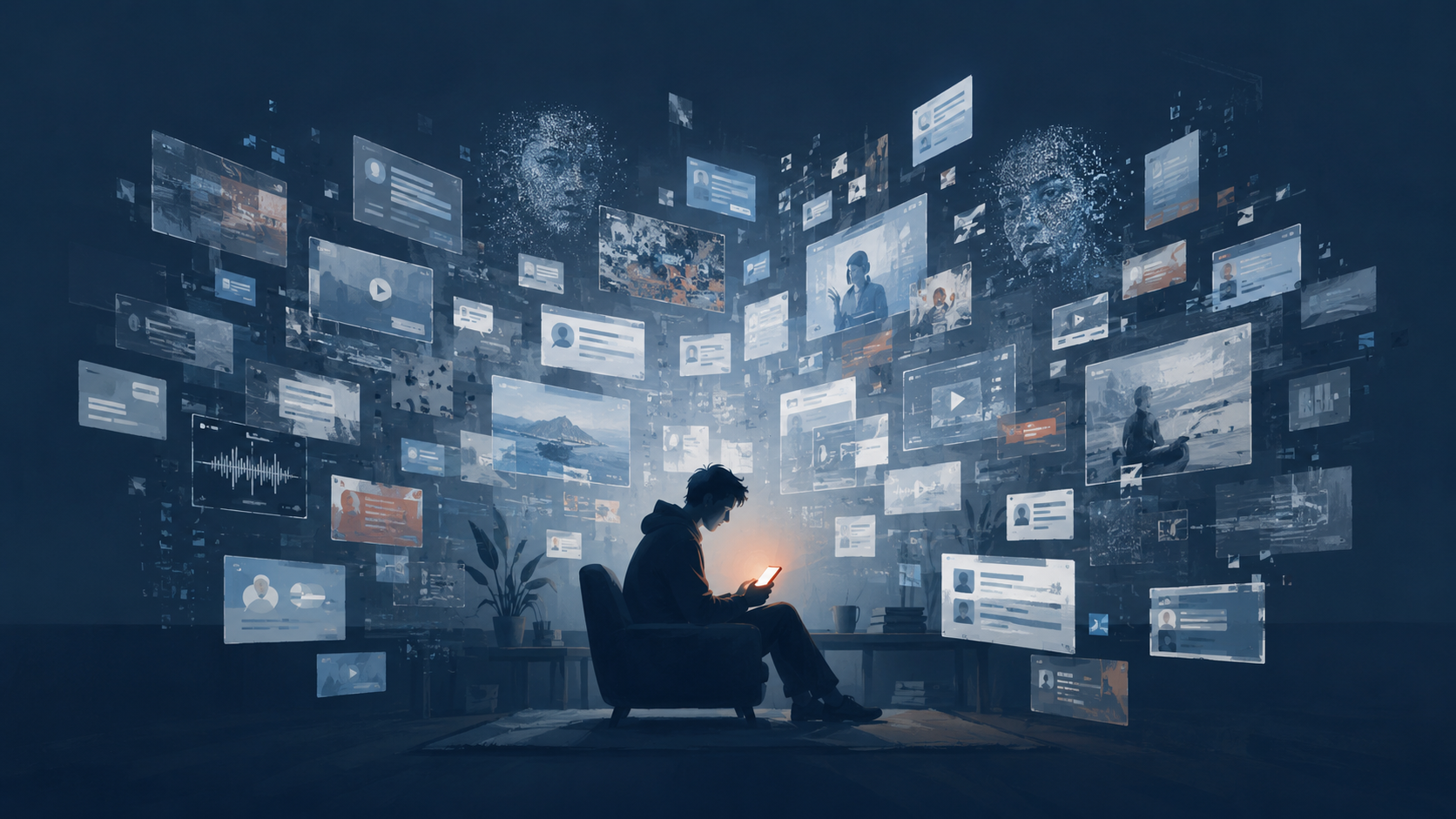 More than twenty years later, the social media landscape looks dramatically different. Some changes were predictable. Others were not.
What is most interesting to me is that social media did not evolve in a single direction. It fragmented. Platforms expanded, audiences diffused, trust shifted, and participation patterns changed in ways few of us anticipated.
Looking back over the past decade, I see the evolution of social media falling into three broad categories: structural changes to the platforms themselves, changes in trust and influence, and changes in how information is distributed and consumed.
Here are ten of the biggest shifts I have observed:
1. Social Media Became the Primary News Source
For millions of people, social platforms have replaced newspapers, television broadcasts, RSS readers, and even direct visits to websites. News is now discovered through scrolling rather than intentional searching. The shift is not subtle. Entire generations now treat their feeds as the default starting point for understanding what is happening in the world.
The deeper change is structural. When news arrives through a feed, the editorial decision about what matters is no longer made by an editor in a newsroom. It is made by an algorithm tuned for engagement, and by whichever account or creator happens to surface the story first.
Most mainstream outlets will decry this change, but most of it is their own fault. They traded neutrality and investigative reporting for opinion and click-trend news-slop, and then acted surprised when audiences stopped trusting them as authoritative sources. The audience did not abandon journalism. Journalism abandoned the standards that earned the audience in the first place.
2. Social Media Became Less Social
People spend more time consuming content than interacting with people. Public posting, commenting, and meaningful discussion have declined, while passive scrolling and entertainment consumption have exploded. The “like” or heart emoji has replaced actual interaction.
What used to be a conversation has become a broadcast. The old 1-9-90 rule about online participation has hardened into something closer to a tiny fraction of users generating the content, a slightly larger group reacting, and the overwhelming majority simply watching. Social media is now a stage, not a room.
This matters because the social value of these platforms was never the content itself. It was the connection. As that connection thins out, what remains is essentially a television channel with a comment section that almost no one reads.
3. The Open Social Web Fragmented Into Smaller Communities
The idea that everyone would gather in a handful of large public networks never materialized, or at least not permanently. Conversations are now spread across Discord, Reddit, Slack communities, WhatsApp groups, newsletters, and countless niche spaces where people congregate largely with others who already agree with them.
The early promise of social media was a global town square. What we got instead is thousands of private rooms, each with its own language, norms, and tolerance for dissent. People feel more connected to their tribe and less connected to anyone outside of it.
Fragmentation has led to isolation. It has also made it harder for ideas, evidence, or even basic facts to travel across community boundaries. The result is a public discourse that feels louder than ever, but is really a collection of parallel monologues happening in separate rooms.
4. Algorithms Replaced Social Graphs
Early social platforms emphasized the people you followed. Your feed reflected your network. If your friends and colleagues were quiet, your feed was quiet. Modern platforms prioritize whatever content is most likely to keep your attention, regardless of whether it came from someone you actually know or chose to follow.
Increasingly, your feed is shaped more by predictive algorithms than by your actual network. The relationship between “who you are connected to” and “what you see” is now weak. You are not really following people anymore. You are being fed by a system that has learned what holds your attention.
If there is one change to be made in social media platforms, it should be to go back to the original model. But the platforms will never revert. There is too much money in optimizing for attention, and not enough money in honoring user intent.
5. Video Became the Dominant Language of Social
Short-form video transformed social media from a communication platform into an entertainment platform. The shift changed content creation, audience expectations, and even attention spans.
Text gave way to images. Images gave way to long-form video. Long-form video gave way to vertical clips designed to be consumed in seconds. Each format change reshaped not only what people make, but how they think while making it. Production decisions are now driven by what fits inside a vertical phone screen and a fifteen-second window.
The consequence is a quiet narrowing of expression. Nuance, context, and slow ideas struggle in a format optimized for instant payoff. Some ideas simply cannot survive the trip into short-form video, and those ideas are getting left behind.
6. Creators Replaced Publishers
Independent creators, analysts, podcasters, streamers, and niche experts now compete directly with traditional media organizations for audience trust and influence. In many industries, individuals now carry more credibility than institutions.
I don’t think this is entirely a bad thing. A subject-matter expert posting from their kitchen often understands their domain better than a generalist reporter on deadline. Audiences have noticed, and have shifted their attention accordingly.
The problem is the underlying economics. Real investigative journalism cannot exist if the clicks do not pay for the work it takes to produce it. We are watching the funding model that supported deep reporting unravel in real time, with nothing fully replacing it. It is a vicious cycle of chasing click-worthy content while the slower, harder, more important work goes underfunded.
7. Trust in Traditional Media Collapsed
Mainstream media increasingly moved from reporting toward commentary and opinion-driven framing. Whether deserved or not, and I think it is mostly deserved, public trust eroded significantly. Audiences drifted toward independent voices, alternative media ecosystems, and creators who at least feel honest about their point of view.
Trust does not collapse overnight. It collapses through years of small decisions: framing language that signals a side, sources that conveniently confirm a narrative, retractions buried under follow-up coverage. Eventually, the audience stops parsing each story and just stops believing the publication on principle.
The problem is that we are quickly drifting toward a true idiocracy because of it. When no institution holds widely shared credibility, every fact becomes negotiable, and every conversation collapses into a question of which side you are on.
8. Organic Reach Declined as Private Sharing Grew
Public feeds became harder to break through organically, while more conversations moved into direct messages, group chats, private communities, and invite-only spaces. Some of the most influential discussions online are now largely invisible to the public web.
This is sometimes called “dark social,” and it is now where many of the most consequential conversations happen. Articles get shared in group texts, ideas spread inside niche Discord servers, and reputations are built or destroyed in Microsoft Teams channels that no outsider can see or measure.
For brands, marketers, and analysts, this is a measurement problem. For the broader information ecosystem, it is something more serious. The visible web increasingly shows only the surface of public sentiment, while the deeper currents move privately, untracked and unaccountable.
9. Outrage Became a Business Model
Platforms discovered that anger and emotional intensity drive engagement more effectively than nuance or reflection. Algorithms increasingly reward reaction over thoughtful discussion, because reaction keeps people active on the platform.
This was not necessarily a deliberate strategy at first. It was an emergent property of optimizing for engagement. But once the pattern was recognized, it stopped being an accident. The systems that surface the most reactive content know exactly what they are doing, and the business models that depend on attention have no incentive to stop them.
The cumulative effect is a feed environment that treats your nervous system as a product. Calm content underperforms. Reasonable content underperforms. Whatever spikes your blood pressure wins, and the people building these systems know it.
10. AI Began Flooding the Ecosystem
Generative AI accelerated content creation at a massive scale. We are now entering an era where feeds are becoming denser, faster, and increasingly difficult to evaluate for authenticity, originality, and intent.
The signal-to-noise problem is real, and it is getting worse. AI-generated articles, images, videos, comments, and entire personas are pouring into platforms that were already struggling with engagement-driven distortion. Distinguishing a real expert from a synthetic one, or a genuine perspective from an automated one, takes effort most users will not invest.
This is the shift I am watching most closely, because it changes the foundational assumption underneath the whole social web: that there is a human on the other end of the post. Once that assumption breaks at scale, every other dynamic on this list gets amplified. Trust gets harder. Outrage gets cheaper. Communities get noisier. And the work of figuring out what is real, and who actually said it, becomes a meaningful part of being online.
What comes next is harder to predict, but a few trends already seem clear.
- First, AI will continue accelerating the volume of online content far beyond human scale. The challenge will no longer be access to information. It will be filtering signal from noise.
- Second, private and trusted communities will likely become even more valuable. People increasingly want smaller circles, trusted voices, and environments where discussion feels authentic rather than performative.
- Third, I think we are going to see renewed appreciation for in-person interaction. Not as a rejection of technology, but as a necessary counterbalance to it.
For all the incredible things social technologies have enabled, many people are exhausted by the constant stream of content, outrage, optimization, and algorithmic manipulation. There is growing value in simply sitting down with other people, turning off the devices, and having real conversations again. For example, I am currently planning with a couple of other local Microsoft MVPs a rebuilding of the in-person Dallas area user group.
Ironically, after two decades of building increasingly sophisticated digital ways to connect with one another, we may be rediscovering something much older and much simpler: human interaction still works best when it is actually human.