
Content Strategy: Let Your Audience Write Your Editorial Calendar
Most content calendars are built on assumptions. Someone in a planning meeting decides what the audience probably cares about, based on gut instinct, last quarter’s analytics, or what a competitor recently published. The resulting content is often competent but slightly off — it addresses a version of the customer’s problem rather than the actual problem, in language that sounds like internal marketing copy rather than the way real customers describe their own pain points.
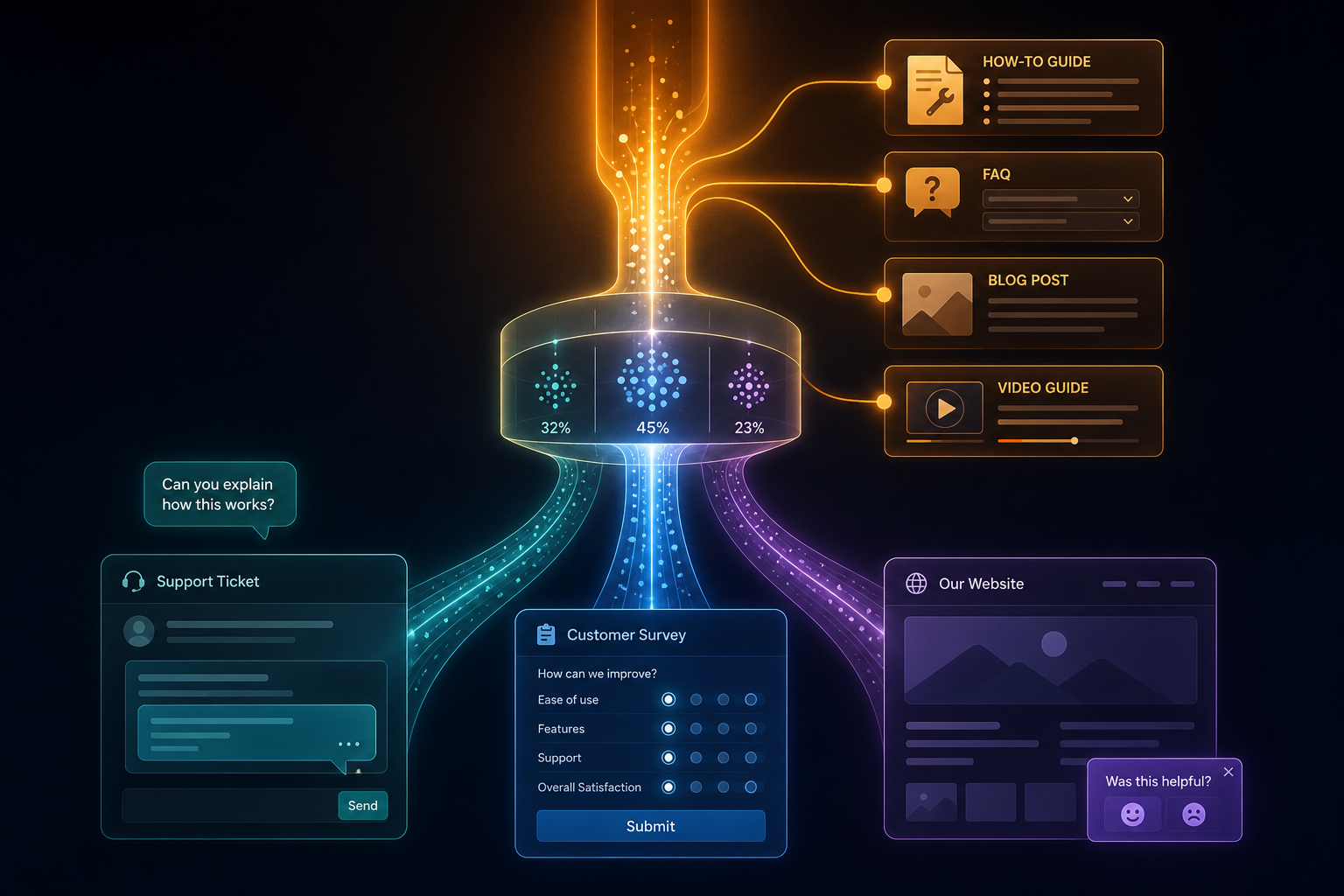 The fix is not more research or better personas, though both help. It is a more direct and structured line of communication between the people who have questions and the people who create content. Pulse surveys, deployed thoughtfully across the right touchpoints, are one of the most practical ways to build that line — and the content that comes out of the other end is almost always more specific, more useful, and more likely to land than content built on guesswork.
This article is part of my ongoing Content Strategy series, designed as a practical reference for individuals and teams who get stuck creating content and want concrete strategies they can actually use. This piece is specifically about how to use pulse surveys not just as a feedback mechanism, but as a structured input into your content strategy — one that closes documentation gaps, surfaces new customer segments, and gives your editorial calendar a direct feed from the people you are actually trying to reach.
What Makes a Pulse Survey Different
Before getting into deployment and follow-through, it is worth being precise about what a pulse survey actually is and what distinguishes it from a standard customer satisfaction questionnaire or an annual NPS exercise.
Pulse surveys are short, frequent, and focused — typically three to five questions at most, designed to capture a specific signal at a specific moment rather than a comprehensive picture of overall satisfaction. They are built to be acted on quickly, which is what makes them useful as content inputs rather than data points that sit in a quarterly report waiting for someone to have time to look at them. The earlier “Mining Customer Feedback Loops” article in this series covers passive feedback — what you learn from support tickets, reviews, and social comments that customers generate on their own. This is the active version of that same idea: going out and asking a specific question at a specific moment, and then doing something concrete with the answer.
One practical caution worth naming upfront: survey fatigue is a real risk, and it shapes everything about how you deploy these. Frequency, length, and placement all matter, and the article will address each. The goal is to be present at the right moments, not everywhere at once.
Three Places to Deploy
Embedded in support and transactional touchpoints. Every resolved support ticket is a natural moment to ask a short follow-up question. The customer just experienced a pain point, got help, and is still close enough to the experience to give you an honest and specific answer. A single question — something like “Was there a guide or resource that would have helped you solve this before reaching out?” — gives you a direct line into content gaps your team may not even know exist. Responses aggregate quickly into a clear picture of what is missing, what is confusing, and what needs to be better explained. Post-purchase and post-onboarding touchpoints work the same way. The customer has just completed a process and their experience is fresh. Two or three focused questions at that moment, kept short enough that it does not feel like homework, captures in-context feedback that is almost impossible to get later.
Periodic customer surveys — comprehensive but not constant. Quarterly or semi-annual surveys give you a broader picture than a single transactional question, and they can go deeper on topics that a one-liner cannot cover. The key design principle is that the survey still has to be easy to complete — short enough to finish in under five minutes — even if the questions are more substantive. The practical note on fatigue: the customers most likely to respond to a periodic survey are often the same customers already responding to your transactional touchpoints. Segment your survey cadence by customer type, tenure, or engagement level to avoid hitting the same people from every direction. A thoughtful outreach schedule is not just courteous — it produces cleaner data because respondents who are not burned out give you more honest, considered answers.
Website-integrated feedback with behavioral context. This is the most technically involved of the three but also the one with the highest potential signal quality, because it captures feedback in context — at the exact moment a visitor hit a friction point or ran out of answers. A short embedded survey on a documentation page, a product feature page, or a pricing page asks a single question in the moment: “Did you find what you were looking for?” or “What were you hoping to find on this page?” The answer alone is useful. The real value is in the behavioral context surrounding it: who the visitor is if known, where on the site they were, what they had read before arriving, and what they did next. That context transforms a simple response into a detailed picture of a customer journey that broke down at a specific point for a specific reason — one you can now address with specific content. Keep the in-page survey to one question, two at the absolute ceiling, and make sure the URL, referrer, and session context are captured automatically so your content team can reconstruct the journey without asking the customer to re-explain it.
Turning Survey Data into Content
The survey is only as useful as what you do with it, and this is where a lot of programs stall. The data comes in, gets added to a spreadsheet, and waits for someone to have bandwidth to act on it. A few practices that keep the signal from going cold:
- Aggregate and categorize responses weekly or biweekly, not monthly. Pain points flagged this week are opportunities this week. The same cluster of feedback that feels urgent on Tuesday tends to feel like background noise by the time next month’s planning meeting rolls around.
- Map recurring themes to content types. A cluster of responses around a specific feature confusion maps to a how-to guide or a FAQ update. A recurring question about a use case not covered in your documentation maps to a new article or video walkthrough. A pattern of customers asking about a problem your product solves that they do not currently associate with your product maps to a positioning or awareness piece aimed at a potentially new customer segment.
- Close the loop visibly. When survey feedback produces a piece of content, tell the people who gave you the feedback. A brief follow-up — “you told us this was confusing, so we built this guide” — turns a data collection moment into a trust moment. It shows customers that the survey was a commitment to act, not just a box-checking exercise.
- Feed the signal upstream. Responses that reveal product gaps or recurring support issues belong in front of your product and engineering teams, not just your content team. The content follow-up addresses the immediate symptom; the upstream signal helps fix the underlying cause.
What the Data Tells You Beyond the Obvious
When you aggregate survey responses over time, patterns emerge that go well beyond “customers are confused about feature X.” You start to see which customer types are asking which kinds of questions, which segments have needs your current content does not address at all, and which pain points are showing up repeatedly in customers who are otherwise highly engaged. That is not just content intelligence — it is market intelligence, and it can inform positioning, product prioritization, and customer success strategy in ways that extend well beyond your editorial calendar.
Pay particular attention to clusters of respondents asking about use cases you have never marketed to. If a meaningful number of customers are describing a problem your product solves that you have never directly addressed in your content, that is a signal worth taking seriously. It may mean you are solving a problem for a buyer you have never spoken to directly — and that your next content investment is not a new blog post, but an entirely new audience.
Build the Habit, Not Just the Survey
Pulse surveys work best when they are a standing practice rather than a one-time initiative. The first deployment will surface some useful insights. The tenth will show you patterns. The thirtieth will give you a living map of how your customers’ needs are shifting over time, which is something no content calendar built on assumptions can replicate. Start with one touchpoint — a post-support follow-up is the easiest place to begin — and build the feedback loop before you build the content. The editorial calendar will take care of itself.