
Stop Judging AI by the Answer
I recently read an interesting article on the Microsoft Tech Community that discussed how organizations should evaluate agentic AI. While it focused on the technical side of measuring quality (bo-ring), it got me thinking about something much simpler: we’re asking the wrong question.
Most people evaluate AI the same way we grade a multiple-choice test. Did it get the answer right? If the response looks good, we move on. If it’s wrong, we try another prompt. Similar to how we’ve always used search.
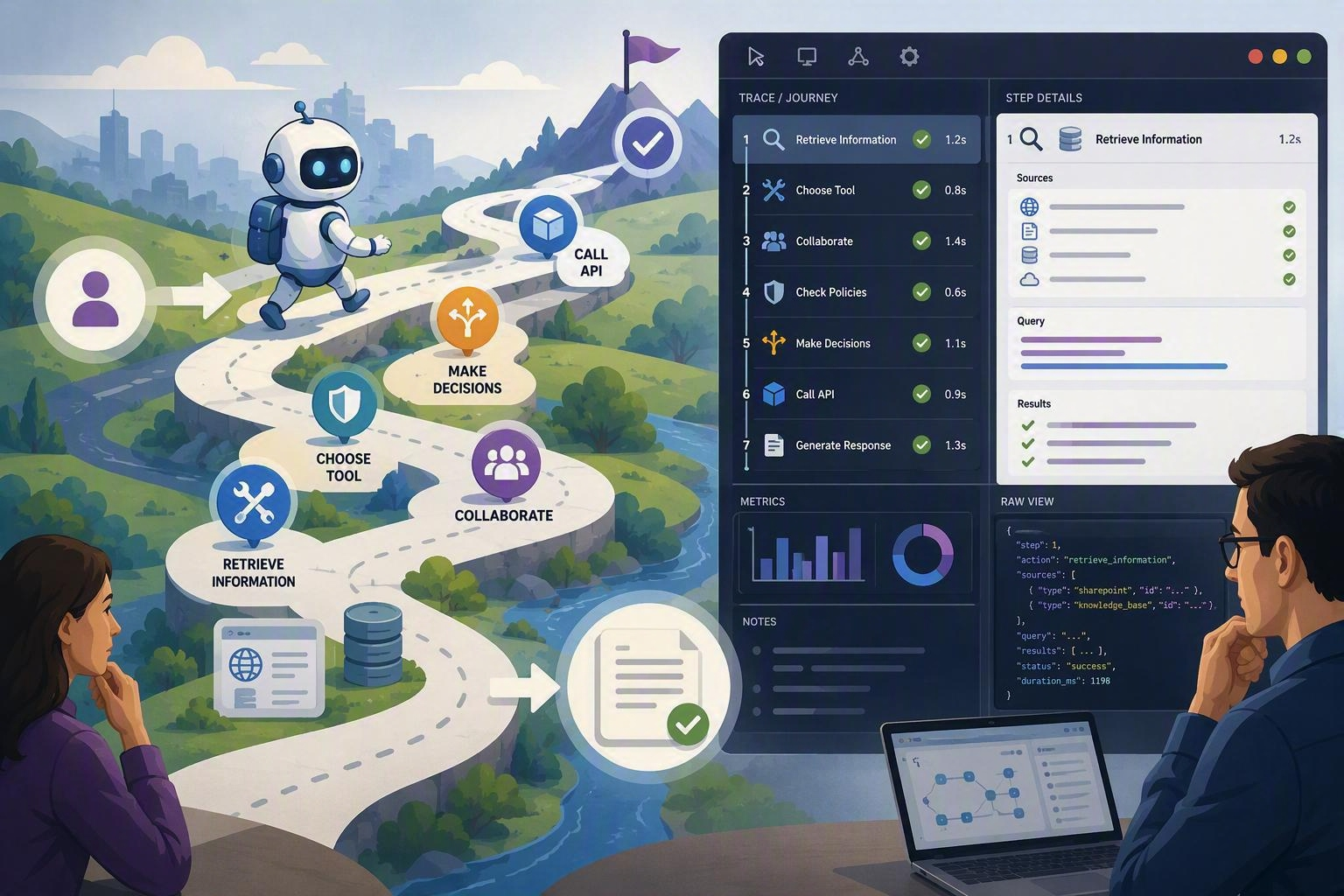 That approach worked reasonably well when generative AI was primarily answering questions or drafting documents. But as AI becomes more autonomous, the final answer becomes only one part of the story.
Think about hiring a new employee. You wouldn’t judge their performance based on one successful project. You’d want to know how they approached the work. Did they collaborate with the right people? Did they use reliable information? Did they follow company policies? Did they make sound decisions when something unexpected happened?
AI deserves the same treatment.
An AI agent isn’t simply generating text anymore. It may be searching multiple knowledge sources, choosing among several tools, making decisions about what to do next, calling APIs, and completing a chain of actions before it ever presents you with a final result. If one of those steps goes wrong, you may still get an answer that looks perfectly reasonable. The problem is that it might have arrived there for all the wrong reasons.
That’s why evaluating AI is becoming less about the destination and more about the journey.
Did the agent retrieve current information or rely on outdated content? Did it access data the user was actually allowed to see? Did it choose the appropriate tool for the task? Did it recognize uncertainty and ask for clarification when needed? Those questions tell us far more about whether the AI can be trusted than simply checking whether the last sentence sounds convincing.
This is especially important as organizations begin deploying AI agents across business processes. A mistake isn’t always obvious. An AI that confidently produces the right answer today may quietly develop bad habits over time as data changes, systems evolve, and new tools are introduced. If we’re only checking the final output, we may never notice those changes until they become real business problems.
Good governance isn’t just about security and compliance. It’s also about visibility. We need to understand how AI systems are making decisions so we can improve them, troubleshoot them, and trust them.
For example, give us something similar to developer tools in the browser that allow us to peer into the html of a page. For AI results, let us see the granular detail of the output so that we can validate the path it took.
In many ways, evaluating AI is becoming much more like evaluating people. We don’t just measure outcomes. We observe behavior, look for consistency, provide feedback, and expect continuous improvement.
The same mindset should apply to AI.
As organizations continue experimenting with agentic AI, I think one lesson will become increasingly clear: the best AI isn’t necessarily the one that gives the right answer the fastest. It’s the one that consistently follows the right path to get there.