
Governance Is a Practice, Not a Project
Most governance initiatives fail. Not immediately, and not dramatically. They fade. A team runs a cleanup effort, documents the standards, gets some early momentum, and then six months later the library looks more or less like it did before. The naming convention is being followed by three people. The owner column is half-populated. The review dates were never set. And nobody is quite sure whose job it is to care.
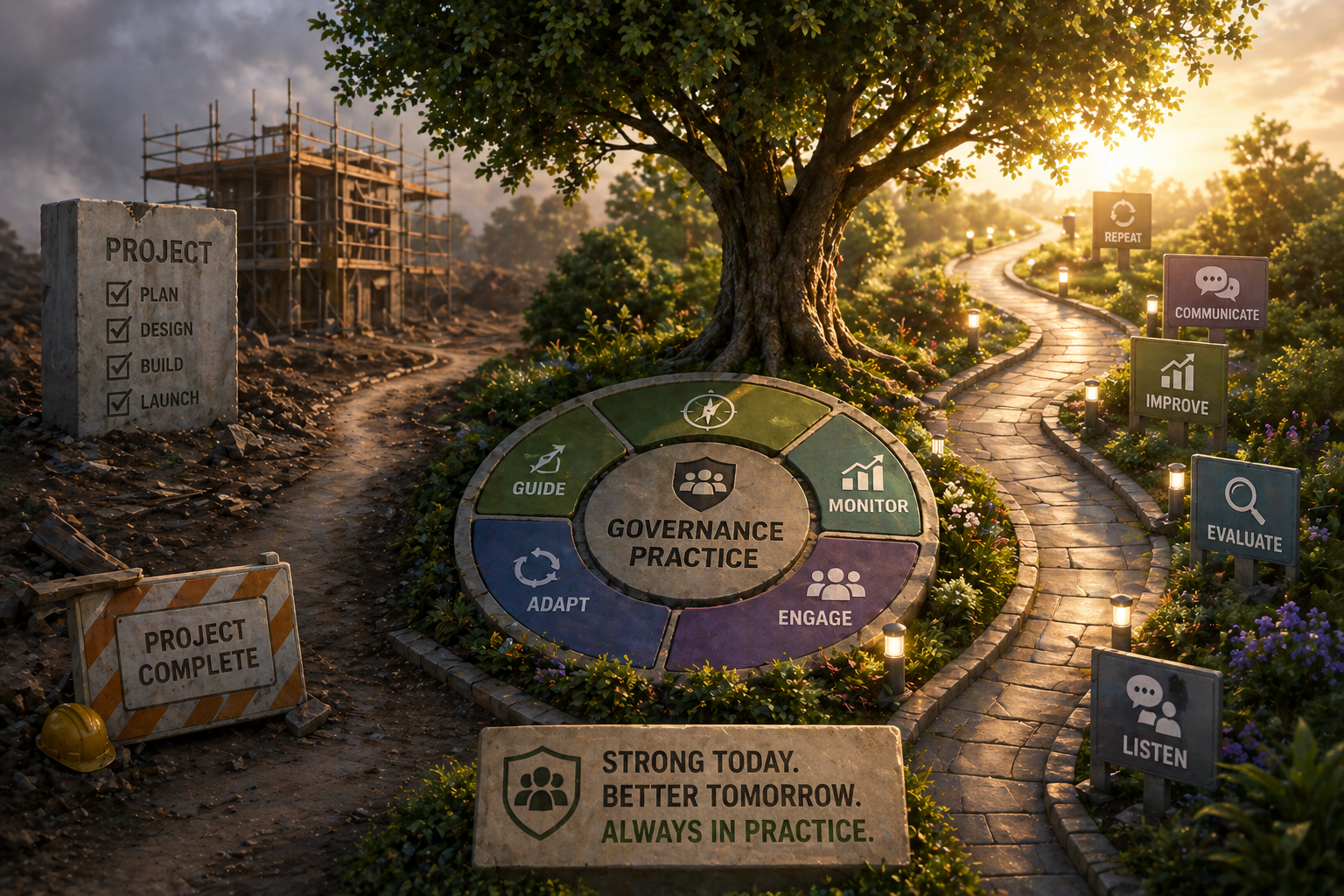 This is not a technology failure. It is a process failure. And it happens for a predictable reason: the governance effort was treated as a project with a finish line instead of a practice that runs continuously alongside the work itself.
Why One-Time Efforts Decay
There is something seductive about the cleanup project model. You identify the problem, you scope the work, you assign a team, you execute, you declare victory. It produces visible results quickly, which creates organizational energy. People feel good about the progress. Leadership sees the before and after.
And then the project ends. The team moves on to the next priority. Nobody was given ongoing responsibility for maintaining what was built. New content starts coming in without the naming convention applied. Old files drift back into active libraries. The review dates that were supposed to trigger quarterly audits pass unnoticed because the Power Automate flow was never actually built. The structural improvements slowly erode under the weight of ordinary daily work.
This is not a failure of effort or intention. It is a failure of design. A governance model that requires a dedicated project to sustain itself will always decay, because organizations have more priorities than bandwidth, and maintenance rarely wins in the competition for attention.
What Actually Makes It Stick
The governance frameworks that hold up over time share three characteristics, and none of them are complicated.
The first is simplicity. Your naming convention should fit on a Post-it note. If following the standard requires reading a policy document, people will not follow it when they are busy, which is always. The rule has to be simple enough to internalize and apply without looking it up. A formula like function, document type, and date in year-month format is specific enough to produce consistent results and simple enough to remember without help.
The same principle applies to metadata. Four columns is a manageable standard. Fourteen columns is a compliance burden that generates creative workarounds. The governance floor should be the minimum that makes AI meaningfully better, not the maximum that a thoughtful governance committee could imagine.
The second characteristic is named ownership. Every document, every library, has one accountable person. Not a team. Not a department. A person, by name, in a People column where SharePoint and Copilot can both reference it. Teams diffuse accountability in ways that feel collaborative but produce orphaned content. When something is everyone’s responsibility, it tends to become nobody’s.
Named ownership also enables automation in ways that shared ownership cannot. A Power Automate flow that sends a reminder to the document owner thirty days before their review date expires is straightforward to build and runs without human intervention. A flow that sends a reminder to “the HR team” requires someone to decide who in that team should act on it, which reintroduces the manual step you were trying to eliminate.
The third characteristic is rhythm. Governance that requires its own dedicated meetings will not survive contact with a busy organization. The quarterly content review that gets scheduled as a standalone governance session is the first thing to disappear when someone needs that time for something urgent.
The version that lasts is the one attached to something that already happens. Ten minutes at the end of a team all-hands. A standing agenda item in a project retrospective. A lightweight check that someone runs before a major deliverable goes live. The governance activity should feel like a natural part of the work, not an administrative tax on top of it.
The Tools That Enforce What People Forget
The most durable governance is the kind that does not depend on people remembering. SharePoint has the infrastructure for this, and most organizations are underusing it.
Content types are the clearest example. When a library is configured with a content type, creating a new document in that library automatically presents the required columns. The user does not have to remember to fill in the Document Type and Owner and Review Date. The fields are just there, required by the structure itself. Governance by default is more reliable than governance by discipline, every time.
Version history gives you an audit trail without any configuration at all. Content approval workflows mean nothing reaches the AI-indexed layer of a library without a human review step. Column default values reduce the cognitive load of compliance for the fields that do not vary often. These are not advanced features requiring specialist knowledge. They are available in every SharePoint environment and require only the decision to use them.
The Power Automate review reminder is worth calling out specifically because it closes the loop that most governance models leave open. Setting a review date in a column is easy. Actually doing something when that date arrives requires either human memory or automation. Build the flow. It takes an hour and it runs indefinitely.
The Real Governance Problem
Here is what I have come to believe after working with organizations across many industries and maturity levels: governance fails not because people do not care about their content, but because the systems they are working in make bad habits easy and good ones effortful.
Fixing that is not primarily a technology problem or a training problem. It is a design problem. When the structure of your environment makes the right behavior the default, governance stops being something people have to remember to do and becomes something that happens as a byproduct of ordinary work.
Simple rules. Named ownership. Built-in rhythm. Those three things, applied consistently to a library that matters, will outlast any cleanup project you have ever run. Start there, and then expand.