
Why AI Is Creating More Writers Than Ever
Every time a new tool lowers the cost of making something, someone predicts the death of the craft. Drum machines were going to kill musicians. Desktop publishing was going to kill designers. Digital cameras were going to kill photographers. What actually happened, every time, is that more people started making music, design, and photographs, and the market had to figure out what “value” meant once the barrier to entry disappeared.
 Writing is having its version of that moment right now, and I think we’re reading the story backward. AI isn’t replacing writers. It’s removing the friction that kept a lot of capable people from ever starting.
The blank page was never really about talent
Most people who don’t write, don’t write because the mechanics get in the way before the ideas do. Structuring an argument, finding the right opening line, wrestling a first draft into something coherent, these are learnable skills, but they’re also the exact skills that stop people cold. I’ve watched smart, experienced professionals sit on genuinely good ideas for years because they didn’t think of themselves as “writers.”
AI collapses that gap. It won’t hand you a good idea, but it will get you past the part where you’re staring at a cursor for twenty minutes trying to find your first sentence. That’s not nothing. For a huge number of people, the hardest part of writing has never been thinking, it’s been starting.
Technical skill is getting cheap. Judgment isn’t.
The second shift is that the technical craft of writing, grammar, structure, pacing, transitions, is becoming commoditized. AI is genuinely good at this part. It’s not particularly good at knowing what’s worth saying, or at knowing something true that nobody else in the room knows.
That’s the part of writing that was always the scarce resource anyway. Original experience. Judgment earned from doing the work. A point of view shaped by actually having lived through the thing you’re writing about. None of that gets automated, and if anything, it’s becoming more valuable precisely because the mechanical skill around it is now cheap and abundant. When everyone can produce clean, competent prose, competent prose stops being the differentiator. Having something to say becomes the differentiator again.
The music industry already ran this experiment
I keep coming back to what happened to music. Digital distribution and peer-to-peer sharing didn’t shrink the amount of music being made, it exploded it. What it did was gut the old economics. The money moved away from recorded output and toward live performance, toward the things that couldn’t be copied and redistributed for free.
I think writing is headed somewhere similar. The economics around pure content production are going to keep compressing, because production is no longer the bottleneck. What doesn’t compress is the stuff tied to a real person: presence, reputation, direct relationship with an audience, the ability to be trusted. That’s where the value migrates.
And here’s the part people get wrong about the flood. I’m not listening to less music because the market got flooded with content. I’m listening to more, and a lot of it is from small, local, or obscure global artists I never would have found in a world with fewer creators and tighter gatekeeping. Abundance didn’t drown out quality. It made discovery the actual problem worth solving.
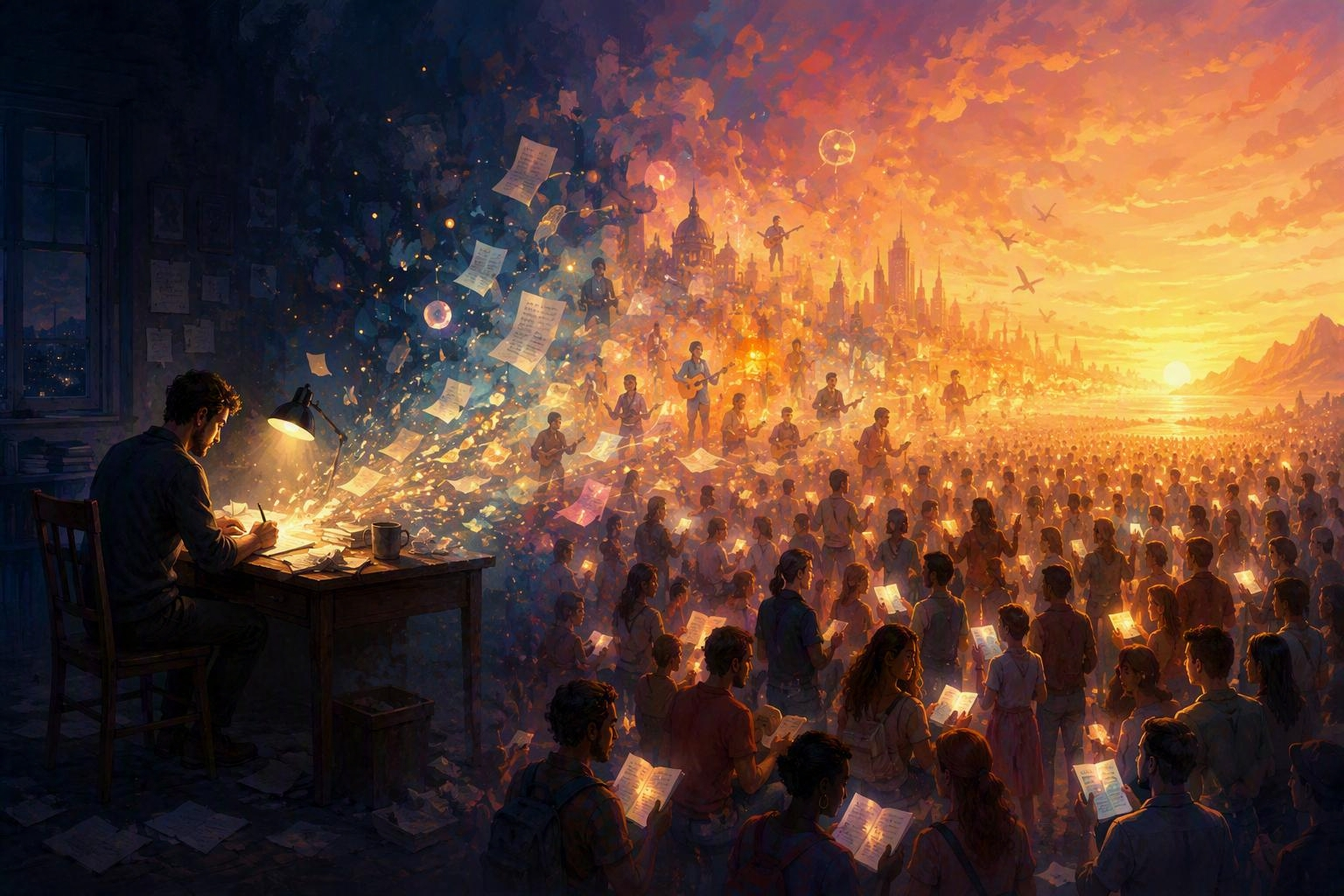 That’s the shift I’d point writers toward too. We don’t need less content in the world. We need better ways to search, filter, and surface it, and we need it delivered in formats people actually want, including places that don’t look like traditional writing at all, like written ideas repackaged into short-form video or audio. The written word isn’t disappearing. It’s just going to travel through more channels than the blog post and the article.
Yes, AI-generated slop is already flooding the internet, and there will be more of it before there’s less. But the same flood that produces slop also unlocks ideas from people who never had a way to get them out before, in places the traditional publishing and media gatekeepers never reached. I’d rather have that trade.
What to actually do about it
A few practical shifts I’d suggest if you’re trying to write more, not less, in this environment:
Use AI to remove friction, not responsibility. Let it help you get past the blank page, but the argument, the claim, the judgment call, that’s still yours to own. If you wouldn’t stand behind a sentence, don’t publish it just because a model wrote it cleanly.
Spend your energy on ideas, not mechanics. The time you used to spend wrestling a paragraph into shape is time you can now spend deciding what’s actually worth saying. That reallocation is the whole opportunity.
Let AI carry the routine work so you can contribute what only you can. Your experience, your judgment, your specific vantage point on a problem, none of that is reproducible. That’s precisely why it’s becoming more valuable, not less.
The barrier that’s coming down isn’t the value of writing. It’s the cost of starting. More people are going to walk through that door than ever before, and the ones who bring something real with them are going to matter more, not less.