
Content Strategy: Increasing Engagement on LinkedIn
I was scrolling LinkedIn recently and came across a graphic from a joint research effort between LinkedIn Ads and Meltwater, the media intelligence and PR platform (more on them here), ranking the content types that earn the most engagement and citations right now.
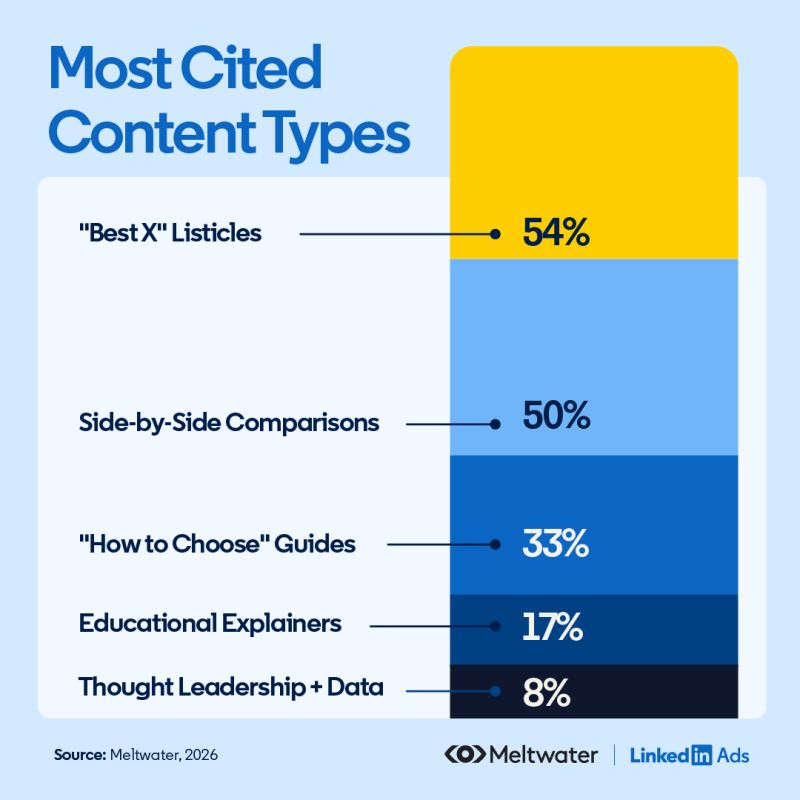
What struck me wasn’t just the data itself, it was the delivery. They used a clean, scroll-stopping “Best X” style visual to market their own findings about which content formats perform best, which means the graphic was essentially proving its own point in real time.
That’s a pretty good trick, and it got me thinking that the list itself deserved a closer look. This article is part of my ongoing Content Strategy series, and this entry exists because a ranked list of formats is one thing, but understanding what each format actually is, how to execute it well, and how to stretch it across every platform you publish on is where the real value lives.
Why These Five Formats Deserve a Closer Look
The LinkedIn Ads and Meltwater research ranked five content types by how often they get cited and engaged with, and the results aren’t especially surprising once you sit with them, but they’re a useful reminder that formats aren’t interchangeable. In a rapidly-evolving world where AI has supplanted tradition search methods, the methods for reaching your target audiences are also changing — and you need to understand the key differences.
Each one is answering a different question for the reader, and each one shows up at a different point in someone’s decision process. Most teams default to whatever format feels most comfortable, usually thought leadership or a general explainer, and end up leaning on one tool for every job. The real opportunity in this data isn’t picking a winner, it’s recognizing that these five formats each deserve a spot in your rotation, deployed intentionally rather than out of habit.
“Best X” Listicles
Topping the list at 54 percent, listicles are the ranked or curated roundup format, things like “the best tools for X” or “seven mistakes to avoid when doing Y.” The structure is simple, but simple isn’t the same as easy, and a listicle only earns its citation rate when every entry carries real substance rather than functioning as filler to hit a round number.
- Anchor every entry in a clear reason, not just a name or a label, so a reader understands why something made the list
- Keep entries roughly equal in depth, since a list that front-loads detail and trails off toward the bottom signals rushed work
- Resist padding to hit a number, because five strong entries beat ten weak ones every time
For cross-platform reach, a listicle is one of the easiest formats to break apart. A single blog post can become a LinkedIn carousel, a short video walking through the top three entries, and a handful of standalone social posts, each built around one item from the list.
Side-by-Side Comparisons
Coming in at 50 percent, comparison content answers a very specific kind of question, which is a reader trying to decide between two or more named options. This format only works when the comparison is honest, since a comparison that obviously tilts toward one option in every category reads as marketing copy rather than genuine guidance.
- Choose criteria that actually matter to the decision, not just the categories that flatter your preferred option
- Present both sides fairly, even when you have an opinion about which option is better, since credibility here is the whole point
- Use a simple table or grid so readers can scan the comparison quickly rather than hunting through paragraphs
Comparison content has real value beyond the blog post itself. It repurposes cleanly into sales enablement material, a one-page PDF prospects can reference during a buying decision, or a slide in a webinar deck.
“How to Choose” Guides
 At 33 percent, this format is close cousin to the comparison but with an important difference. Instead of putting two named options head to head, a “how to choose” guide builds a decision framework the reader can apply on their own, even to options you never mention by name.
- Identify the two or three factors that actually drive the decision, and organize the guide around those rather than a generic checklist
- Use real scenarios to illustrate how the framework plays out differently depending on someone’s situation
- Avoid steering too hard toward your own product, since the value of this format is the framework itself, not a disguised pitch
This format extends naturally into an email nurture sequence, where each stage of the decision framework becomes its own message, or a short explainer video walking through the same logic.
Educational Explainers
Explainers sit at 17 percent, lower than the first three formats but still an essential piece of the mix. This is foundational, “what is X and why does it matter” content, and while it doesn’t earn the same citation volume as the formats above it, it often serves as the raw material those other formats draw from.
- Keep the language genuinely accessible, avoiding industry jargon that assumes prior knowledge your reader may not have
- Answer the obvious follow-up questions within the piece itself rather than leaving readers to search elsewhere
- Treat explainers as reusable source material, since a strong explainer can seed several listicles, comparisons, and guides down the road
Thought Leadership + Data
At just 8 percent, thought leadership paired with original data cites the least of the five formats, and if you’ve invested heavily in this kind of content, that number might sting a little. But a low citation rate doesn’t mean the format has failed, it means the format is doing a different job. Thought leadership builds differentiation and trust over time rather than earning quick citations, and that’s a distinction I made in Commodity Content and the Thought Leadership Problem, where the argument was that better thinking matters more than chasing volume.
- Pair a genuine point of view with original data, since data alone without perspective just reads as a report
- Commit to the format’s slower payoff, measuring it by relationship and authority built rather than short-term citation counts
- Extend its life deliberately, since thought leadership pieces make excellent source material for speaking engagements, podcast conversations, or a recurring newsletter
A Composite Example
As part of my series template, I try to provide real-world examples, many times coming from my own customer examples. Case-in-point: picture a mid-sized B2B SaaS company that had been defaulting almost entirely to thought leadership posts, publishing one substantial piece every few weeks and calling it a content strategy.
After reviewing this data, the team rebuilt its calendar to rotate deliberately through all five formats. A comparison post became the backbone of a new sales enablement one-pager. A listicle turned into a LinkedIn carousel and three standalone social posts spread across two weeks. A “how to choose” guide fed directly into an email nurture sequence for mid-funnel leads. And thought leadership stayed in the mix, but now reserved for a monthly newsletter where the goal was relationship and authority rather than raw citation volume.
The output didn’t necessarily increase, but the coverage across formats and platforms did, and that’s really the shift worth making.
Building a Format Mix, Not a Format Hierarchy
It’s worth being clear about what this data is and isn’t telling you. It’s not a ranking of which format is objectively “best,” it’s a signal of what’s currently earning visibility and citation. The smartest response isn’t abandoning thought leadership because it cites lowest, and it isn’t defaulting to nothing but listicles because they cite highest. It’s treating all five formats as a toolkit, matched deliberately to the question a reader is actually asking and the stage they’re at in their decision.
And once you’ve committed to a format, the real multiplier comes from what I covered in Extending Your Reach with Micro Content, which is treating each core piece as a source for smaller, platform-specific assets rather than a single post that lives and dies on your blog.
Increasing engagement on LinkedIn, or anywhere else, isn’t about chasing whichever format is trending this month. It’s about knowing which job each format is built for, and building a calendar that uses all of them well.