
Good Technology Doesn’t Fix Broken Systems
When AI adoption falls short of expectations, organizations usually start looking for individual explanations. Employees need more training. Managers need to encourage experimentation. Maybe people simply aren’t embracing change quickly enough. Those explanations are easy to understand because they focus on individuals. They’re also incomplete.
Sometimes the greatest barrier to AI adoption isn’t the people expected to use the technology. It’s the environment they’re expected to use it in.
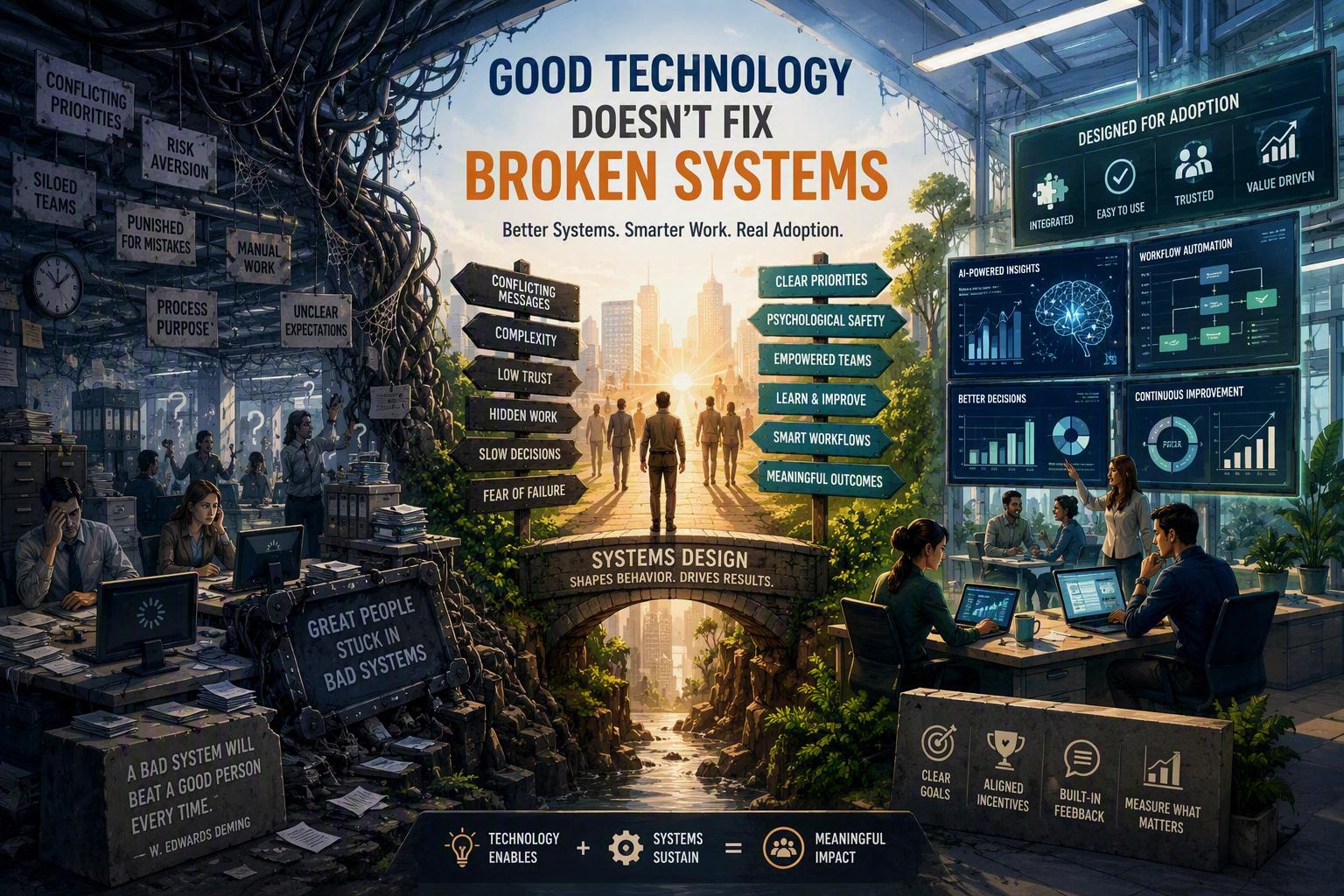 Organizations are systems, and people respond to those systems far more consistently than they respond to motivational speeches or a one-time training session. If the organizational system rewards one behavior while the messaging encourages another, people almost always follow the incentives rather than the messaging. That’s not resistance. It’s rational behavior. W. Edwards Deming put it more bluntly: “A bad system will beat a good person every time.”
Organizational systems teach us what really matters
Every company has official values. Most also have operating values. The official values appear on websites, posters, and onboarding presentations. The operating values are discovered through experience. Employees quickly learn what behaviors get recognized, what mistakes get forgiven, who gets promoted, and what happens when something goes wrong. Those observations shape behavior far more effectively than any policy document.
When leaders say they want experimentation but only reward predictability, employees learn which message to believe. When innovation is encouraged right up until the first visible mistake, people become remarkably innovative at avoiding risk. The organizational system has spoken.
AI often exposes contradictions that already existed
One reason AI adoption has proven so challenging is that it exposes inconsistencies organizations have been carrying for years. Consider how many employees hear some version of: we want you to innovate, don’t make mistakes, think creatively, follow the established process, experiment with AI, be sure nothing goes wrong. Individually, none of those statements seems unreasonable. Together, they create an impossible balancing act.
Employees aren’t really choosing between AI and traditional work. They’re trying to satisfy competing expectations that can’t always be satisfied at once. When adoption slows, the problem isn’t necessarily uncertainty or lack of effort. Sometimes people simply don’t know which organizational expectation matters most.
Systems produce predictable behavior
Behavioral scientists often remind us that incentives shape outcomes, and the same principle applies inside organizations. If employees are evaluated on speed alone, they’ll avoid anything that initially slows them down. If they’re evaluated on error reduction, they’ll hesitate before experimenting with an unfamiliar tool. Those aren’t signs of poor attitudes. They’re signs that people understand exactly how success gets measured.
Organizations frequently interpret these choices as resistance to AI. Employees experience them as good judgment. As Deming put it, “every system is perfectly designed to get the results it gets,” and the results organizations are seeing are usually an accurate reflection of the system they built, whether or not they intended it that way.
Adoption isn’t an individual achievement
One of the biggest mistakes organizations make is measuring adoption person by person: how many employees logged in, how many prompts were written, how many licenses were activated. Those numbers are easy to collect. They’re also poor indicators of meaningful change.
Real adoption happens when work changes. Meetings get shorter because summaries generate automatically. Project updates get more consistent because first drafts stop starting from a blank page. Research happens faster because information gets synthesized instead of manually collected. Those are organizational outcomes, not individual achievements. The goal isn’t getting employees to use AI. The goal is redesigning work so AI naturally becomes part of it.
Leaders model systems more than speeches
Employees pay remarkably close attention to what leaders actually do. If executives encourage AI but never use it themselves, people notice. If managers require AI-generated work while refusing to adjust deadlines, people notice. If leadership celebrates successful experiments but quietly punishes unsuccessful ones, people notice. Every decision communicates something about the organization’s true priorities. Culture isn’t created through announcements. It’s created through repeated observations of leadership behavior, and people rarely need to be told what matters. They infer it.
The easiest path usually wins
Organizations sometimes assume widespread adoption requires extraordinary motivation. Usually, it requires better design. If AI requires employees to open another application, remember another password, and justify every use case, adoption becomes another task competing for attention. If AI appears naturally inside the applications people already use and fits existing workflows, adoption becomes much less of a decision. People generally don’t seek the most innovative path. They choose the path that lets them accomplish their work with the least unnecessary friction. Good organizational systems make the desired behavior the easiest behavior. Poor ones make it the hardest.
Technology reflects organizational design
Looking back across the ideas explored in this series, a common pattern emerges. People hesitate when uncertainty is high. They avoid unnecessary mental effort. They protect the professional identities they’ve spent years building. And they respond rationally to the organizational systems surrounding them. None of those behaviors are irrational, and none of them suggest employees are unwilling to change. They simply demonstrate that technology adoption has never been primarily about technology.
AI is forcing organizations to confront something much larger than a software deployment. It’s revealing how clearly they communicate, how thoughtfully they design work, how consistently they reward behavior, and how much they trust their people to exercise judgment. The organizations that succeed won’t necessarily have the most advanced AI. They’ll have the strongest organizational systems, because good technology can improve work, but only good systems can make that improvement sustainable.